Build the Foundation of a JavaScript Conversational AI Agent
You no longer need a research lab to build a capable JavaScript Conversational AI Agent that talks, remembers, and gets real work done. A practical starter path uses n8n as the workflow layer and a large model (e.g., OpenAI) as the agent’s brain, then adds short-term memory so the bot keeps context across turns. With a few nodes, beginners can wire up facts from Wikipedia, fetch recent headlines via Google Search, and even send follow-up summaries through Gmail. Logging to Google Sheets makes outcomes reviewable and auditable, while a simple knowledge base prevents duplicates from repeating to users. If 30% of support questions are repetitive, automating just two minutes per case across 500 tickets saves roughly five hours a week. Pairing this with a natural “chatgpt voice” experience turns a static bot into a friendly guide. For teams that want real-time voice and automation out of the box, Sista AI adds a voice UI controller, session memory, and instant embeds without a long integration cycle; you can try the live experience in the Sista AI Demo.
Choose Platforms and Architecture With Intent
Before coding, decide how your JavaScript Conversational AI Agent should be built and maintained. No‑code agent platforms like Lindy, Rivet, or Bedrock Agent provide drag‑and‑drop builders, ready-made prompts, and built-in integrations that help non‑developers ship fast. Developer frameworks such as LangChain, React, or CrewAI allow deeper control over memory, tool calling, and custom logic, but require infrastructure, observability, and deployment know‑how. Regardless of stack, define clear triggers so the perceive→reason→act loop starts reliably—think “new email received,” “Stripe payment posted,” or “CRM lead updated.” Manage the context window purposefully: persist recent turns, user profile data, and active goals while trimming noise to control cost and latency. Embed behavioral instructions that cover tone, tasks, and fallbacks, and set guardrails for tool usage and escalation. Teams who plan self‑hosting upfront often achieve more predictable costs and data control. If you’re deploying to the web, Sista AI’s universal JS snippet and SDKs for React, Shopify, and WordPress make it straightforward to add real-time voice plus automation to your existing stack without re‑architecting.
Design Persona, Flows, and Memory That Feel Human
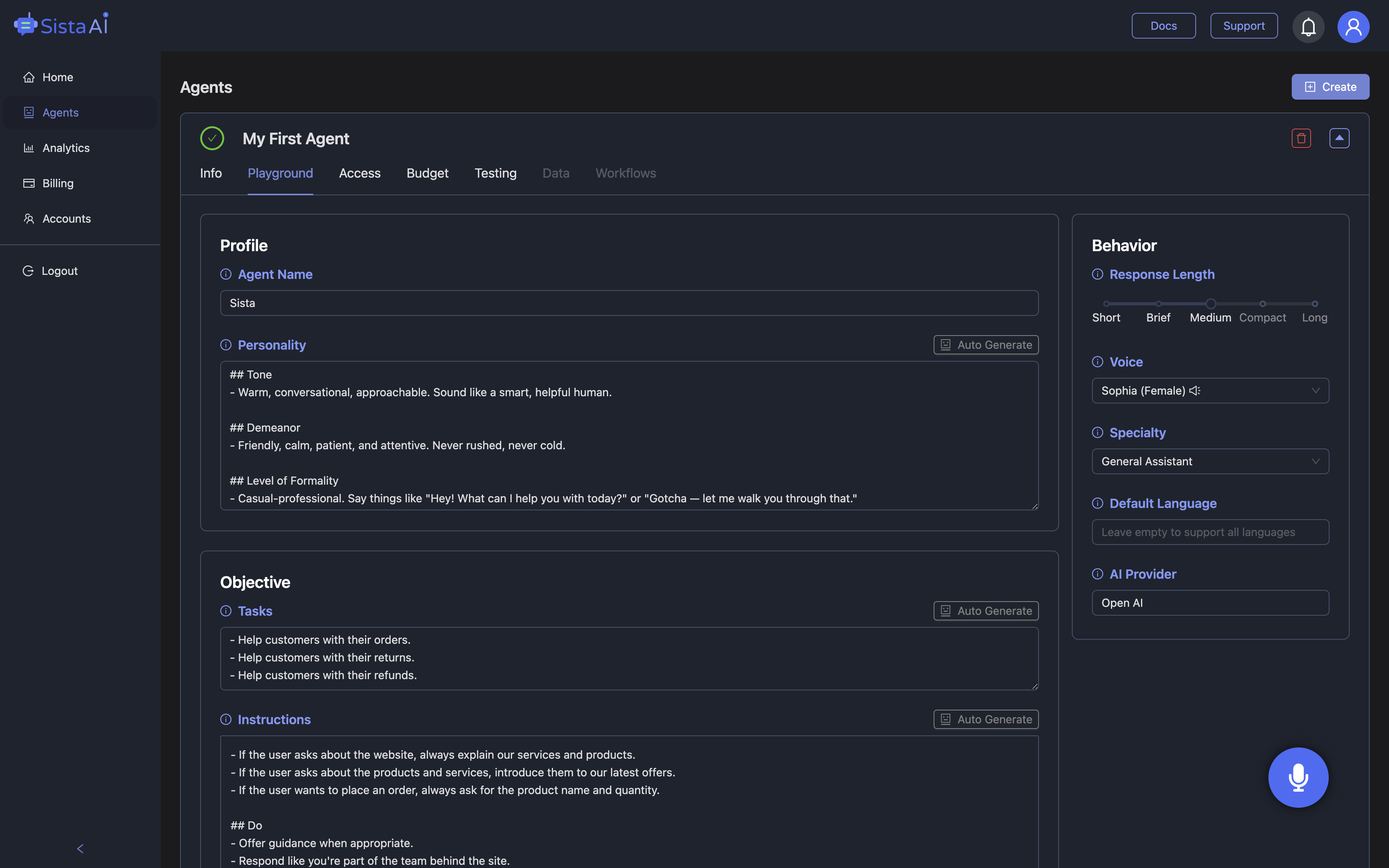
Effective agents start with crisp prompt engineering and a well-defined persona that matches your brand’s audience. Draft a short charter for your JavaScript Conversational AI Agent—what it should do, not do, and how it speaks under pressure. Map key conversation flows, including entry questions, decision points, and graceful handoffs to humans for edge cases. Seed the agent with sample dialogs, real transcripts, and FAQs so it learns your language and knows the common answers. Use a layered memory strategy: short-term turn memory for continuity, a knowledge base for durable facts, and a duplicate manager to avoid repeating known content. Set measurable outcomes such as first-contact resolution, average turn count, or handoff rate, and test weekly with small cohorts to see how behavior changes. A simple example is onboarding: greet, collect role and goals, confirm tools, then email a summary plan and log it to Sheets. Sista AI helps here with session memory, integrated RAG for private knowledge, and multilingual voices so the persona remains consistent across languages and channels.
Wire Tools and Automation That Deliver Outcomes
Tools are where a JavaScript Conversational AI Agent becomes more than a chatbox. Connect Wikipedia for quick facts, Google Search for current events, and Gmail to send alerts, briefings, or receipts. Use scheduling to trigger autonomous tasks—like a daily news digest or weekly account health summary—and log results into Google Sheets for transparency. Output beautification with Markdown keeps responses readable, and AI-enhanced formatting helps summaries land clearly in email or chat. A concrete workflow might greet a user, gather preferences, fetch three recent headlines, add one Wikipedia background paragraph, and email a personalized briefing—no human needed. The same pattern can handle customer updates, internal checklists, or status reports. This approach pairs neatly with a “chatgpt voice” front end so users can hear summaries hands‑free. For web and app contexts, Sista AI layers on workflow automation, a voice UI controller that can scroll, click, and type, plus full‑stack code execution to call APIs or run JavaScript securely—turning conversations into completed tasks.
Deploy Across Channels and Measure What Matters
Plan deployment like a product launch: start on your website or app, then expand to mobile and other touchpoints once performance stabilizes. Prioritize low latency and accessibility so the voice experience feels natural; Sista AI supports ultra‑low latency and over 60 languages to meet global and inclusive needs. Track cohort-level metrics—intent coverage, abandon rate, and average resolution time—and run A/B tests on prompts, tools, or voice personas. Keep a human-in-the-loop path for complex issues and record escalations to refine agent instructions. Update the knowledge base regularly and trim stale facts to maintain accuracy. For teams on CMS platforms like WordPress or Shopify, Sista AI’s plugins and universal JS snippet simplify rollout in minutes rather than weeks. Centralize configuration and permissions in an admin dashboard so product and ops teams can tune behavior without redeploying code; you can sign up to manage agents, voices, and usage from a single place.
From Prototype to Production With Sista AI
The most reliable path is iterative: prototype workflows in n8n or a code framework like LangChain, validate with small user cohorts, and then productionize with hardened integrations and voice. As you scale, treat your JavaScript Conversational AI Agent like a product: maintain prompts, version flows, and monitor outcomes as if they were features. When you’re ready for real-time voice, UI control, and cross‑platform deployment, Sista AI offers plug‑and‑play voice agents, session memory, RAG knowledge, and automation that embed in any web or app stack. The result is an agent that can speak, act, and report—improving support, onboarding, and commerce journeys without a rewrite. Want to experience voice-first interaction in action? Explore the live Sista AI Demo. Ready to roll it out to your site or product team today? Sign up to launch your first production-ready agent and tune it from a single dashboard.
Stop Waiting. AI Is Already Here!
It’s never been easier to integrate AI into your product. Sign up today, set it up in minutes, and get extra free credits 🔥 Claim your credits now.
Don’t have a project yet? You can still try it directly in your browser and keep your free credits. Try the Chrome Extension.

For more information, visit sista.ai.