The new standard for an AI voice assistant app
Customers now expect to talk to software, not hunt through menus, and that is why the modern AI voice assistant app has become a must-have. In 2025, comparison guides list a wide spectrum of assistants, from omnichannel platforms like Zendesk’s voice AI with a 14-day trial to voice-first specialists such as PolyAI. Consumer tools still matter too, with Siri leaning into privacy, Alexa praised for accessibility, and Google Assistant known for call handling. Newer entrants add variety: Gemini emphasizes conversational flow at $19.99 per month, while Bixby focuses on device control on Samsung hardware. Some tools blur categories—Otter.ai excels at meetings and summaries from $8.33 per user monthly, and ChatGPT with Voice offers general conversation on a $20 plan. Research-oriented Perplexity and productivity-focused Microsoft Copilot Voice both hover around $20, while Meta AI is free and Jasper targets marketers at $59 per seat. Enterprise options such as Spitch and VOCALLS round out the market with automation depth and custom deployments. What these comparisons reveal is that features are specialized, but most businesses need a single AI voice assistant app that speaks naturally and can also perform work. That is precisely the gap Sista AI aims to close, delivering plug-and-play voice agents that embed into websites and mobile apps with real-time automation. If you want to hear how this feels in practice, try the Sista AI Demo to experience a live agent in your browser.
What to evaluate before you build
Choosing an AI voice assistant app starts with fundamentals: reliability, speed, privacy controls, and multilingual support. Beyond small talk, the assistant should grasp domain context through a connected knowledge base and retrieval that keeps answers consistent with your policies. Look for session memory so conversations continue naturally, and for graceful fallbacks to chat or human handoff when confidence drops. For front-end ergonomics, voice UI control—being able to scroll, click, type, and navigate—turns voice into a genuine input method rather than just a speaker. On integration, teams value minimal setup: universal JavaScript snippets, out-of-the-box SDKs, and plugins for stacks like React, Shopify, or WordPress. Sista AI’s embeddable agent covers these bases with over 60 languages, low-latency streaming, workflow automation, and a no-code dashboard to configure permissions. Consider a university portal where students ask “What’s my payment deadline?” and then say “Submit my tuition”; an effective AI voice assistant app should answer and complete the task. In an e-commerce storefront, buyers might request “Show hiking boots under $120, size 10,” then “Add the second pair to cart” and “Apply my loyalty,” all via voice. These patterns require tight coupling between understanding, action, and UI control—areas where Sista AI was designed to operate from day one.
Natural-sounding voices and real work
Natural sound matters too, and 2025’s voice synthesis shows how far an AI voice assistant app has come. ElevenLabs is frequently cited for lifelike speech, flexible voice cloning, and emotive tags—whispering, laughter, or sarcasm—with a free tier and paid plans starting at $5. Multilingual AI dubbing in tools like an AI Dubbing Studio helps content teams localize explainer videos without re-recording sessions. Yet lifelike tone alone does not solve business needs; value emerges when speech recognition, language understanding, decisioning, and actions combine in one loop. General chat experiences such as chatgpt voice are excellent for brainstorming and Q&A, but production workloads need permissions, guardrails, and deterministic workflows. Sista AI leans into this orchestration layer with real-time conversation, integrated retrieval-augmented generation, on-screen summarization, and session memory that respects context. Because the agent understands interface structure, it can talk through a process and also operate it, keeping latency low enough that the dialog stays natural. Picture a global support center where a caller starts in Spanish, switches to English, then asks to “reset MFA now”; the system should keep state across languages and finish the flow. This blend of natural voice and dependable action is precisely what makes an AI voice assistant app feel helpful rather than novel.
From talk to action: automation that ships outcomes
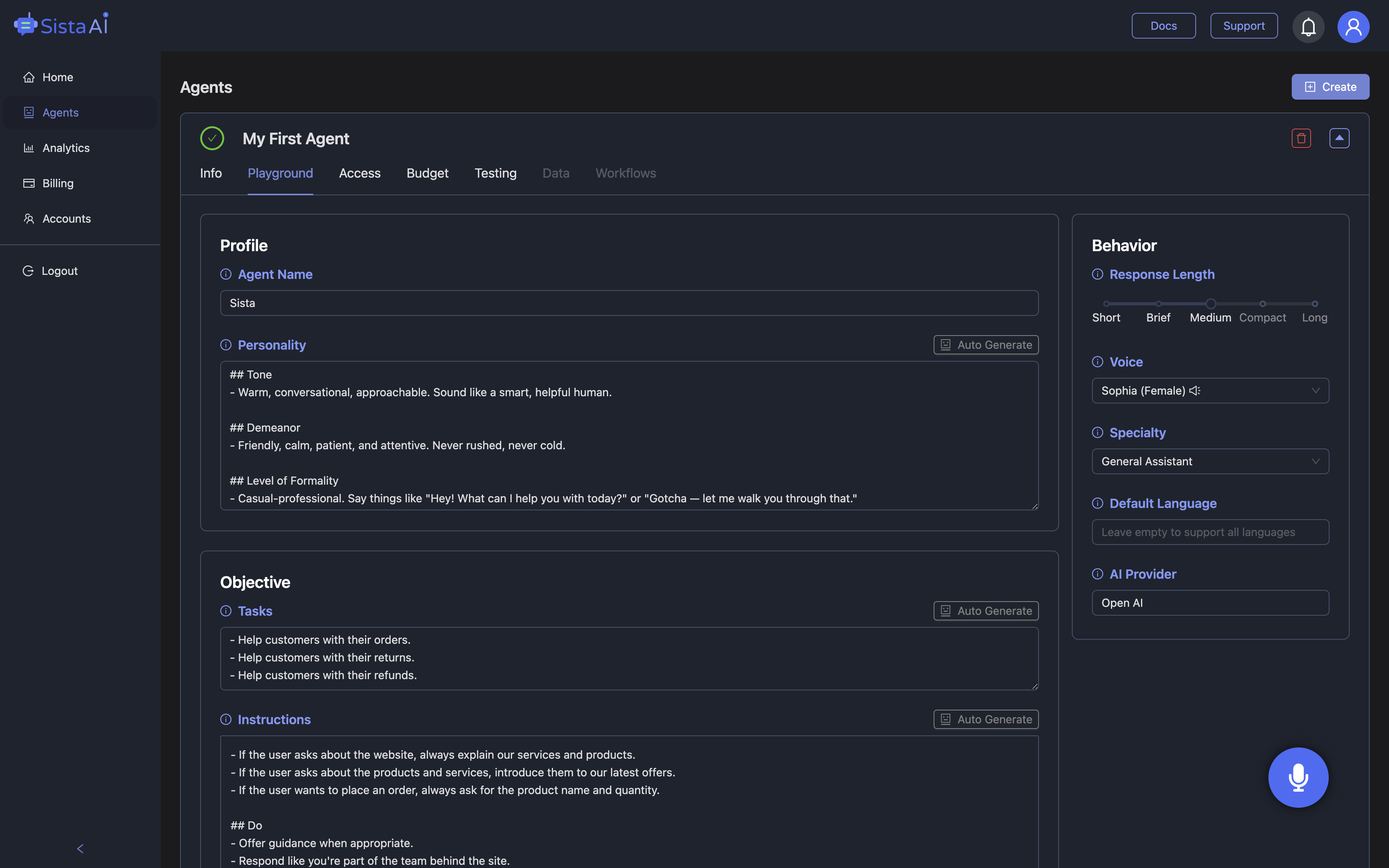
The true test is turning words into outcomes, and that is where automation features separate a good AI voice assistant app from a great one. Sista AI’s Voice UI Controller executes interface actions—scrolling, clicking, typing, or navigating—while workflow automation chains back-end steps without exposing credentials. Full-stack code execution lets teams validate inputs, call APIs, and write results, enabling tasks like account recovery, claims intake, or appointment scheduling. Session memory keeps multi-turn tasks on track, and permissioning ensures the agent acts only within the boundaries you set. On the commerce side, the Shopify AI Sales Agent supports product discovery by voice, smart cart management, guided checkout, and order tracking with promotion awareness. Imagine a 30-second voice journey: “Show trail shoes with ankle support,” “Compare the top two,” “Add the lighter pair,” “Use my points,” and “Ship to my office.” That is a complete funnel without a single click, an accessibility improvement and a conversion lift rolled into one. While note-taking tools such as Otter or productivity suites with voice like Copilot shine in meetings, this class of agent is optimized for hands-on, transactional work. You can configure behaviors, intents, and data sources in Sista AI’s admin panel, then embed the agent via a script tag or SDK when you are ready.
A rollout plan you can trust
A practical rollout plan for an AI voice assistant app starts small and expands deliberately. Pick one high-volume journey, define the intents and guardrails, and design a clear persona with the tone your brand wants. Connect authoritative knowledge sources and required APIs, then run a closed-beta pilot with real users before enabling public traffic. Instrument the experience with handle-rate, containment, average handle time, and satisfaction tracking, and set thresholds for live handoff. Ensure privacy and accessibility from day one, including consent prompts, redaction for sensitive fields, and compatibility with assistive devices. Iterate weekly by reviewing conversation logs, improving retrieval snippets, and adding new automations as patterns emerge. Sista AI supports this lifecycle with a no-code dashboard, session analytics, and consultancy for mapping user journeys and architecting AI-native workflows. If you want to hear the interaction loop for yourself, explore a working agent in the Sista AI Demo, then review the transcript and actions afterward. When it is time to operationalize, sign up to configure your first deployment, connect data sources, and ship a production-ready assistant in days, not months. Ready when you are: try the live demo to experience voice-first automation, and create your account to bring an AI voice assistant app to your site or app.
Stop Waiting. AI Is Already Here!
It’s never been easier to integrate AI into your product. Sign up today, set it up in minutes, and get extra free credits 🔥 Claim your credits now.
Don’t have a project yet? You can still try it directly in your browser and keep your free credits. Try the Chrome Extension.

For more information, visit sista.ai.