From Manual Workflows to Autonomous Agents
Every team is swamped with repetitive tasks—form processing, inbox triage, meeting scheduling—yet these are exactly where an ai agent builder shines. In 2025, agentic systems don’t just draft replies; they plan, reason, and execute steps toward a goal with minimal hand-holding. Reuters projects revenue from agent solutions to reach $52 billion by 2030, a signal that this isn’t a fad but an infrastructure shift. Deloitte describes this class of tools by their agency, the autonomy to act on human-set goals instead of just responding. If you’ve experimented with chatgpt voice for quick answers, imagine extending that to actions like creating tickets, updating CRM fields, or booking slots. The most practical builders now offer no-code or low-code flows that abstract APIs and logic. That means faster prototypes, shorter feedback loops, and safer routes to production. As these tools mature, the question isn’t if you’ll use an ai agent builder, but where to start and how to make it reliable.
Choosing an AI Agent Builder for Your Context
Not all platforms target the same job. Recomi, for example, leans into no-code setup—upload files, build a knowledge base, and embed on your site or Slack—great for support deflection or onboarding. MetaGPT shows up more developer-centric, appealing when you need fine-grained control around prompts, tools, or environments. Relevance AI offers a quick ramp for team automations with an intuitive UI, but it isn’t built for deep cross-system, compliance-heavy workflows. Beam AI lands at the other end of the spectrum as an enterprise-grade operating system for autonomous agents with governance, auditability, and reliable execution across finance, HR, and customer service. This split illustrates a core tradeoff: ease of use versus end-to-end rigor. A practical approach is to map your tasks by risk and complexity, then pick the ai agent builder that matches each lane. Low-risk tasks like FAQ handling or intake can live on a no-code stack. High-stakes processes benefit from enterprise platforms that enforce policy and traceability. Even exploration costs are getting lighter—some ecosystems mention credits (like Google Cloud’s $300 for Vertex AI) to de-risk early trials.
Why Voice-First Agents Change the Experience
Text bots sped up support, but voice changes how users feel about automation. A voice-first agent can clarify intent, gather details faster, and operate interfaces hands-free. If you’ve tried chatgpt voice for quick Q&A, the leap to voice-driven actions—clicking, typing, navigating—is where real productivity kicks in. This is where Sista AI is useful: its plug-and-play voice layer slots into websites and apps without code rewrites, then executes commands like scroll, click, and form-fill while talking naturally. The agent handles over 60 languages, keeps short-term memory during a session, and can summarize on-screen content in real time. Consider a support site where a visitor says, “Show my last invoice and open a ticket if it looks wrong.” A Sista AI agent can fetch the right page, read relevant data, confirm context, and complete the flow. Teams embed it via a universal JS snippet or framework-specific SDKs, reducing effort and time-to-value. You can try a hands-on example in the Sista AI Demo to see voice interactions driving real actions.
A Practical Rollout Plan That Scales
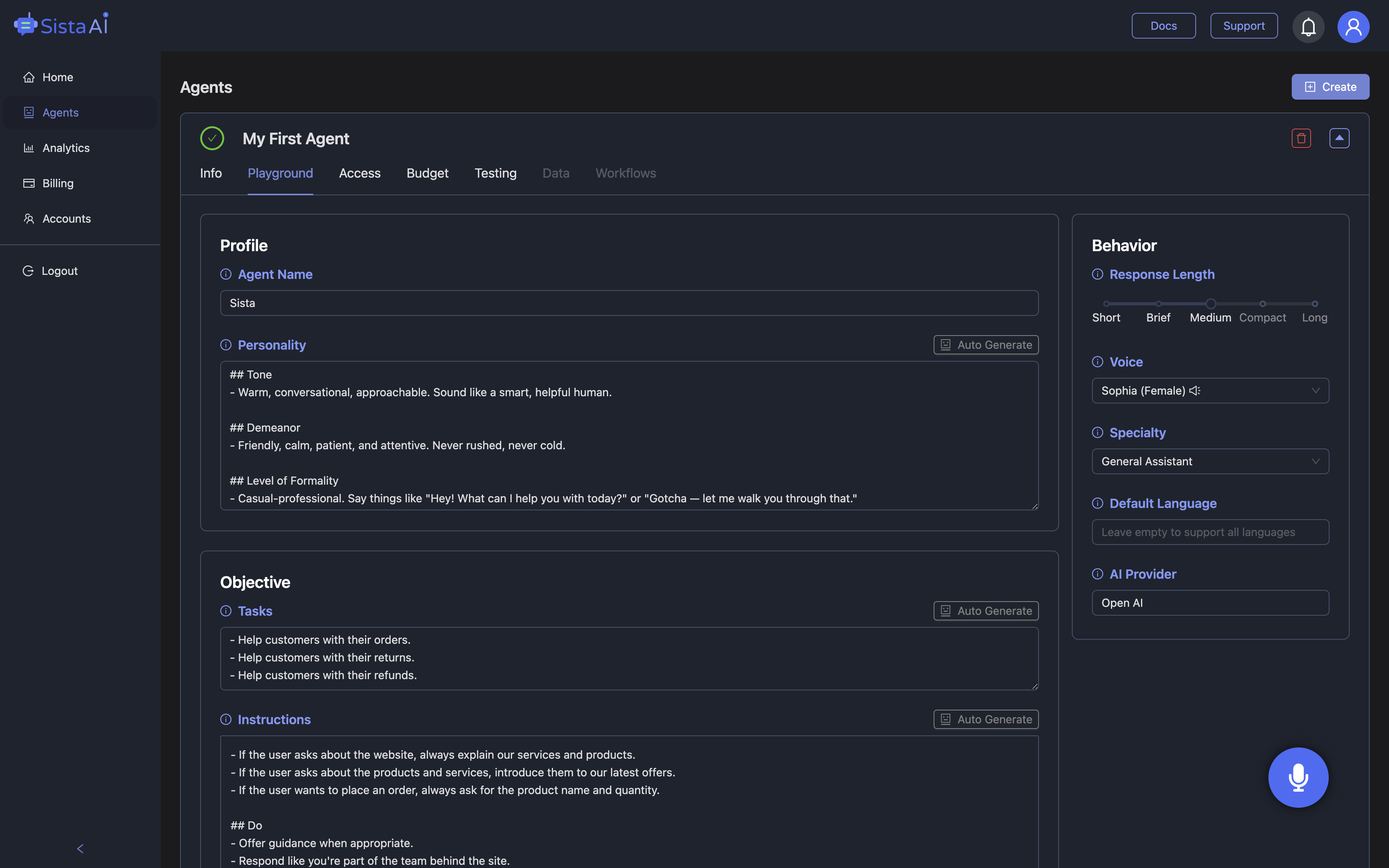
Start by inventorying candidate workflows: what’s repetitive, rules-based, and bounded by existing policies. Choose an ai agent builder that fits each stream—no-code for intake and triage, enterprise-grade for regulated or cross-system processes. Next, craft a minimal but accurate knowledge base and retrieval setup; clear sources beat large, messy dumps. Add tool integrations for CRM, calendars, ticketing, or databases so the agent can act, not just talk. Layer governance early: define what the agent can read, change, or escalate, and capture logs for audits. Now bring in Sista AI as the voice interface and UI controller to reduce friction for end users and boost accessibility. Its no-code dashboard lets you configure permissions, personas, and analytics, while integrated RAG adds context securely. For commerce teams, the Shopify-ready voice agent guides discovery and checkout; for internal portals, the browser extension speeds research and form-filling. When your pilots feel stable, enroll more use cases and set SLOs so reliability scales with adoption. Create an account in the Sista AI Signup panel to manage agents, keys, and environments in one place.
Measure Outcomes and Build Confidence
Define concrete metrics: task completion rate, time-to-resolution, handoff quality, and user satisfaction. Track false escalations, authorization errors, and any drift from playbooks; these reveal where training data or tool access needs tuning. In customer support, test whether the agent resolves billing or order issues end-to-end without human edits. In HR, see if it reliably routes requests and updates records across systems with proper audit trails. For product teams, measure activation and retention when a voice agent guides onboarding or fills complex forms. As you harden governance and expand integrations, your ai agent builder becomes a backbone for automation, not a side experiment. Voice adds approachability, while robust backends add trust. If you want to experience a production-ready voice layer that complements your chosen builder, try the interactive Sista AI Demo, then sign up to configure an agent for your site or app today. It’s a practical way to align modern agentic trends with real workflows without overhauling your stack.
Stop Waiting. AI Is Already Here!
It’s never been easier to integrate AI into your product. Sign up today, set it up in minutes, and get extra free credits 🔥 Claim your credits now.
Don’t have a project yet? You can still try it directly in your browser and keep your free credits. Try the Chrome Extension.

For more information, visit sista.ai.