Introduction
If your home’s most-used remote is your voice, you’re not alone. By late 2024, an estimated 111.1 million people in the U.S. were using smart speakers, and usage keeps rising into 2025. The AI voice Assistant speaker has become the default interface for music, routines, and quick answers, and there are now roughly 8.4 billion voice assistants in use worldwide. About 20.5% of people rely on voice search, and 27% of mobile users use it on the go. Accuracy is high—roughly 93.7% of voice queries are answered correctly—and responses arrive fast in about 4.6 seconds on average. That speed and reliability explains why 76% of consumers use assistants to find local businesses nearby. Google Assistant, Amazon Alexa, and Apple Siri dominate, but generative systems like chatgpt voice are reshaping expectations. This guide explains where smart speakers are headed and how to bring that same experience to your own digital product.
The 2025 AI Voice Assistant Speaker Landscape
Today’s leaders pair strong ecosystems with everyday utility. Google Assistant shines for personalized routines, multi-language understanding, and deep Android and Nest integration, though it’s strongest within Google’s ecosystem and can stumble on especially complex commands. Amazon Alexa is renowned for its broad device support—from Echo speakers to Ring cameras and Fire TV sticks—and excels at shopping, delivery tracking, and flexible multi-user routines. Apple Siri retains a massive installed base, especially on iPhones and HomePods, with reliable hands-free tasks and continuity across Apple devices. Specialized players add nuance: Hound (SoundHound) tackles complex multi-part queries, while options like DataBot and even legacy assistants such as Microsoft Cortana occupy niche roles. Amazon’s new Alexa+ injects generative AI into the mix for more conversational, task-completing interactions. For a typical morning, an AI voice Assistant speaker can dim lights, start coffee, summarize overnight news, and queue a commute route—all without touching a screen. As expectations rise, assistants that “get things done” across devices are becoming the default benchmark.
Beyond Speakers: Voice Is Everywhere
Voice assistance is quickly escaping the living room. Smart glasses from Meta, Google, and Solos now support real-time conversations, while VR headsets, especially those like Meta’s Quest paired with conversational AI, let you navigate and create with your voice. In connected cars, major automakers such as Stellantis and Volkswagen are integrating ChatGPT for natural in-car control—an evolution many drivers describe as chatgpt voice for the road. Earbuds, TVs, appliances, and even bicycles are gaining microphones and intent recognition, turning voice into a true cross-context interface. Meta AI, powered by Llama 4 and designed for full-duplex conversation, shows how assistants can keep up across apps and wearables. Privacy still matters: always-on mics raise trust questions that vendors address with clearer controls and processing safeguards. When choosing beyond an AI voice Assistant speaker, evaluate ecosystem fit, multilingual performance, low latency, memory for context, and how well it handles multi-step tasks. The more consistent the assistant across devices, the more useful it becomes.
Bringing Speaker-Grade Voice to Your Product with Sista AI
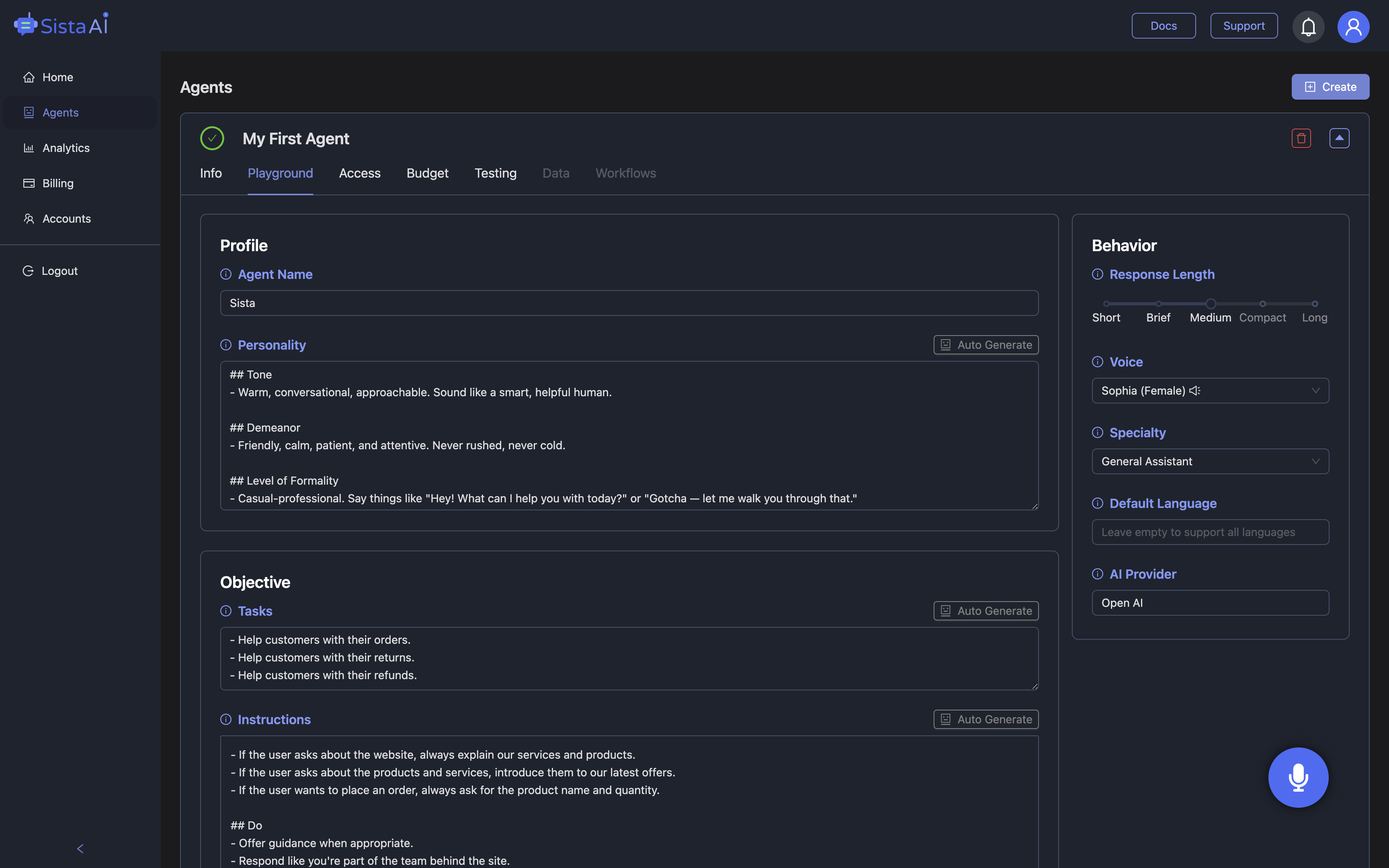
What if your website or app felt as helpful as an AI voice Assistant speaker—yet tailored to your content, workflows, and users? Sista AI offers plug-and-play voice agents that drop into any digital experience via a universal JavaScript snippet or SDKs for frameworks like React, Shopify, and WordPress. These agents combine real-time conversational understanding with a Voice UI Controller that can scroll, click, type, and navigate on command. Workflow automation handles multi-step tasks—think scheduling, form-filling, or status lookups—while Integrated RAG and knowledge bases keep answers accurate to your domain. Multilingual support covers 60+ languages, ultra-low latency keeps dialogue natural, and short-term session memory preserves context across turns. Because accessibility matters, the agent can summarize on-screen content like an automatic screen reader. If you want to see what voice-first really feels like in a browser, try the live Sista AI Demo and prototype a speaker-grade experience in minutes.
Practical Next Steps and Getting Started
To bring voice to your product, start small and focused. First, pick one high-impact journey—onboarding, product discovery, account updates, or support triage—and define success signals like faster completion or fewer steps. Second, scope permissions for the Voice UI Controller so the agent can safely click, type, and navigate where it should. Third, connect your documentation or knowledge base so answers stay grounded in your domain. Fourth, design an agent persona and guardrails to match your brand. Fifth, test latency, fallbacks, and handoff to human support. Organizations adopting voice generally report faster task completion, lower support load, and improved accessibility across devices. If you’re ready to experiment, you can sign up and go from idea to a working prototype without rewriting your stack. Prefer to see it in action first? Jump into the Sista AI Demo and talk to your product like it’s sitting inside a smart speaker.
Stop Waiting. AI Is Already Here!
It’s never been easier to integrate AI into your product. Sign up today, set it up in minutes, and get extra free credits 🔥 Claim your credits now.
Don’t have a project yet? You can still try it directly in your browser and keep your free credits. Try the Chrome Extension.

For more information, visit sista.ai.