Why Conversational AI matters in 2025
Customers expect answers in seconds, not minutes, and teams are feeling the pressure across support, sales, and operations. Conversational AI has matured into a practical way to meet that demand, combining natural language understanding, context retention, and integrations that take real actions. The market spans proven platforms like ChatGPT Enterprise, Google Dialogflow CX, Microsoft Azure Bot Service, Kore.ai, and Rasa, each solving different parts of the journey. Voice is surging too, from modern IVR replacements to hands-free browsing and shopping, with chatgpt voice becoming a common entry point for many users. Selecting the right stack now influences your cost-to-serve, data privacy posture, and time-to-value for years. A useful approach is to separate your “brains” (models and flows) from your “experience layer” (web, app, or phone). That’s where a voice-first interface shines: it reduces friction and increases completion rates when the task is complex. Sista AI helps here by embedding a real-time, voice-driven agent directly into your site or app, so users can talk, navigate, and complete tasks without leaving the page. You can experiment quickly with a live voice agent using the Sista AI Demo to see how voice changes your funnels in practice.
How to evaluate a Conversational AI platform
When comparing Conversational AI options, prioritize multichannel reach across web, mobile, telephony, and social because users rarely stay in one lane. Accuracy in NLP/NLU matters for intent recognition and entity handling, but so does context awareness that remembers previous messages and applies them to the next step. Analytics should move beyond dashboards to actionable insights that improve flows, staffing, and outcomes. Compliance is nonnegotiable in healthcare and finance; ChatGPT Enterprise brings SOC‑2 controls, while Dialogflow CX adds European-hosted Neural2 voices and defenses against prompt injection. Deep integrations are critical, from CRMs and ERPs to ticketing, payments, and analytics, ensuring your bot can do real work, not just chat. Low-friction training workflows keep teams shipping; Azure Bot Service and Kore.ai both provide low-code build tools to speed iteration. Rasa offers maximal flexibility when you need on‑premises control and custom pipelines. In that context, Sista AI contributes the experience layer: a plug-and-play voice UI with 60+ languages, session memory, workflow automation, and integrated RAG so agents can speak from your knowledge base. Setup is fast with a universal JavaScript snippet or plugins for platforms like WordPress and Shopify, allowing you to pilot without heavy engineering.
Market reality: models, ecosystems, and your roadmap
The landscape is concentrated but evolving: ChatGPT and Microsoft Copilot together command more than 74% market share, with Google Gemini at roughly 13.5%. Perplexity sits around 6.5% as a research-forward assistant, and Claude at about 3.5% emphasizes long-context enterprise tasks. Smaller entrants like Grok, DeepSeek, Brave Leo AI, Komo, and Andi differentiate on privacy, lightweight delivery, or domain focus. These dynamics suggest two practical moves for teams: hedge against lock-in and design for agility. Use the best model for each task—retrieval-heavy knowledge answers might favor one tool, while transactional workflows and telephony might favor another. Your competitive edge isn’t only the model; it’s the conversation design, integrations, and the interface users actually touch. Voice is especially potent where hands are busy or screens are cluttered, such as field services, healthcare intake, or guided shopping. A pragmatic tactic is to pair your chosen back-end platform with a flexible front-end layer. By embedding Sista AI’s real-time voice agent as that front-end, you preserve freedom to evolve models and flows while keeping a consistent, delightful experience for users.
Practical use cases you can ship now
Service businesses offer a clear example: ServiceAgent.ai reports a 30–40% increase in booked jobs by understanding domain terms like “ridge vent” or “sewer jetting” and responding immediately. That demand for voice-first speed translates well to websites, where a Sista AI agent can greet visitors, qualify leads, schedule appointments, and even navigate forms by voice. In e-commerce, a Shopify store can add a conversational layer for product discovery, comparisons, and cart management, guiding shoppers who would otherwise bounce on crowded pages. Customer support sites benefit from a 24/7 voice attendant that triages issues, checks order status via CRM, and escalates to a human when necessary. Education platforms can let learners ask for summaries, definitions, or next-step recommendations without clicking through menus. Healthcare organizations can capture intake information conversationally while honoring data-locality requirements through back-end choices. Internal portals can augment onboarding with a voice coach that explains policies, fills forms, and triggers approvals. Sista AI’s agent combines voice UI control, workflow automation, and knowledge grounding so these scenarios work inside your existing pages—no redesign required.
Getting started: a simple implementation playbook
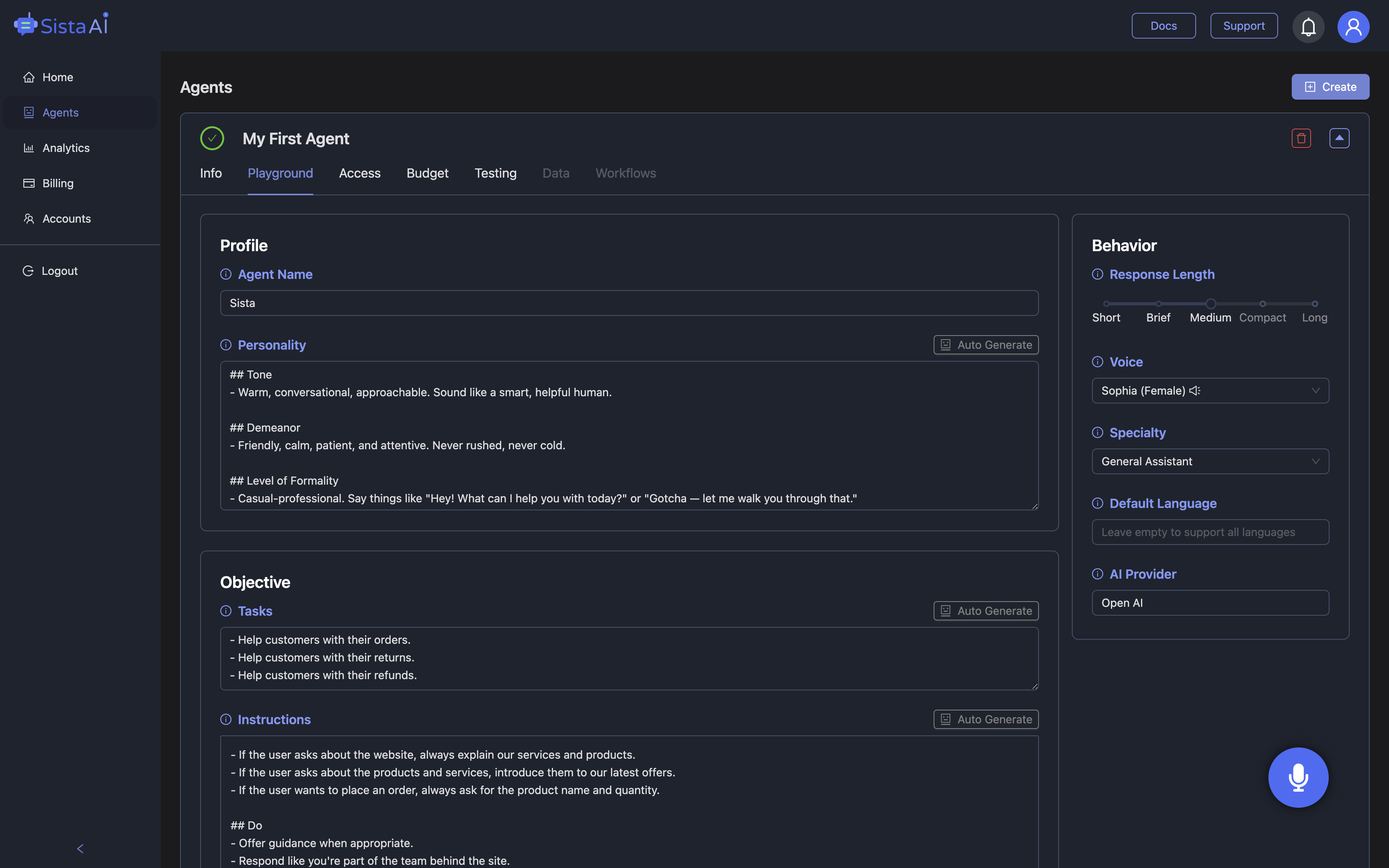
Start by mapping the top five intents that matter most to outcomes—booking, order tracking, returns, account updates, or FAQ heavy hitters—then write short success criteria for each. Choose your channels: web voice agent, mobile, telephony, or a mix. Pick a platform for orchestration and compliance (Dialogflow CX, Azure Bot Service, Rasa, or others) and plan guardrails against prompt injection. Connect CRMs, ticketing, and payment systems so conversations can complete real tasks, not just answer questions. Pilot with a small cohort, measure containment, handoff quality, and task completion, then iterate weekly. Sista AI fits as the experience layer: embed a voice agent in minutes, configure permissions in a no‑code dashboard, attach your knowledge base, and let the agent execute multi-step workflows or run code when needed. Because Sista AI supports over 60 languages with ultra-low latency and session memory, you can deliver fast, human-like interactions without writing a new app. If you want to see what this feels like before committing, try the live Sista AI Demo on a real webpage. When you’re ready to roll out your first production agent, you can sign up and deploy to your site or store in an afternoon, then expand based on what your analytics show.
Stop Waiting. AI Is Already Here!
It’s never been easier to integrate AI into your product. Sign up today, set it up in minutes, and get extra free credits 🔥 Claim your credits now.
Don’t have a project yet? You can still try it directly in your browser and keep your free credits. Try the Chrome Extension.

For more information, visit sista.ai.