From Chat to Action: Why AI Agent Frameworks Are the Next Leap
Teams are moving beyond static chatbots toward systems that can plan, call tools, and take action, which is exactly where AI agent frameworks shine. Instead of one-off prompts, these frameworks coordinate reasoning, memory, and workflows so agents can complete multi-step tasks reliably. The rise of chatgpt voice interactions has also raised expectations: people want to talk naturally, not click through menus. Voice-first experiences add constraints like latency, streaming, and context carryover that many stacks ignore. Sista AI approaches this gap with plug-and-play voice agents designed for real-time conversation, workflow automation, and UI control. Its SDKs and universal JS snippet make it easy to embed voice intelligence in web or mobile apps. If you prefer to listen rather than read, you can explore a working agent in the Sista AI Demo to see how these ideas sound in practice.
The Building Blocks That Make Agents Useful (and Safe)
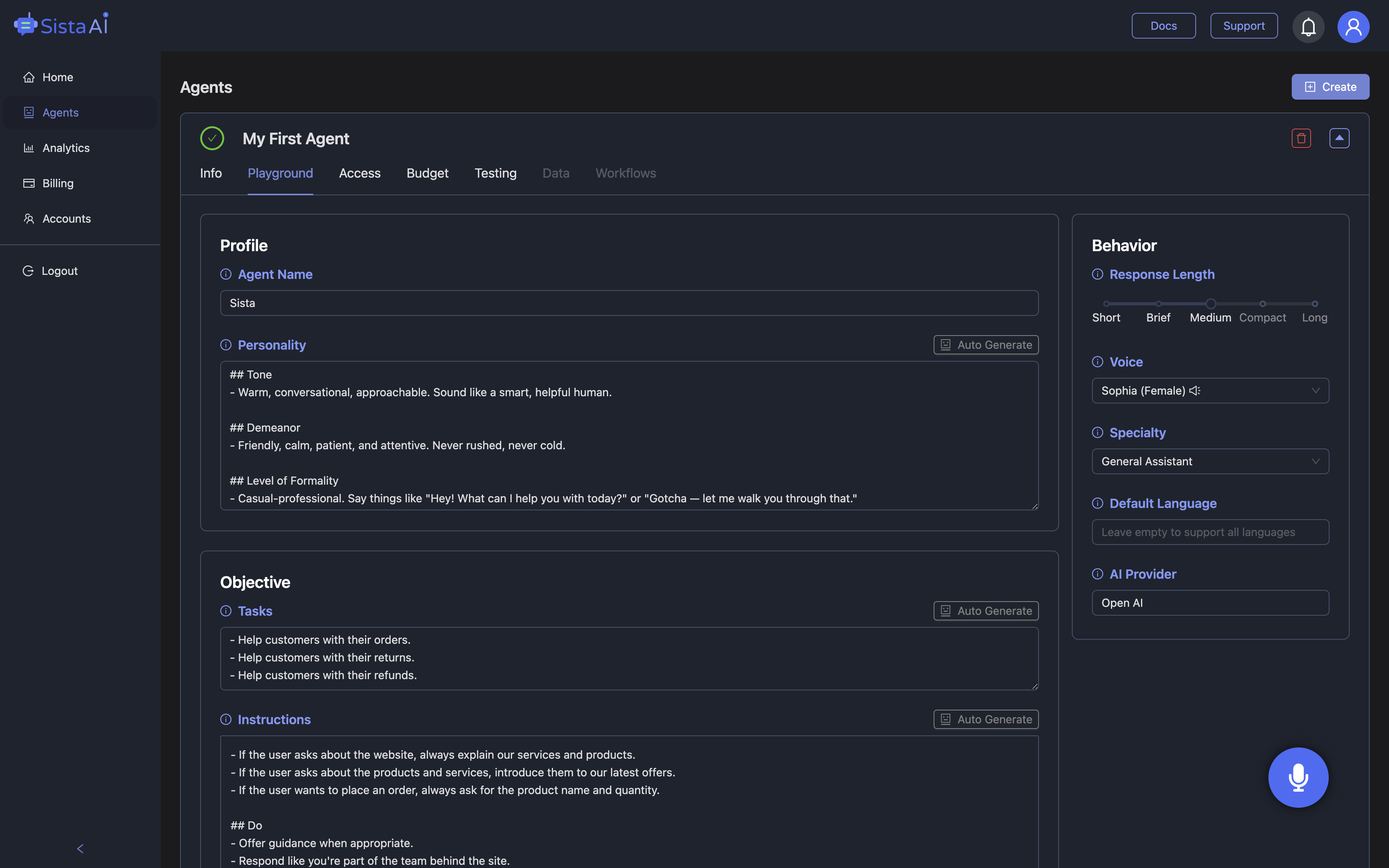
Strong AI agent frameworks share a few core pieces: a policy or planner that decides next actions, tool execution for APIs and databases, short-term memory for the current task, and knowledge retrieval for facts and documents. They also include guardrails, authentication, and observability so you can debug and trust outcomes. Imagine a returns workflow: the agent verifies order details, checks eligibility, generates a label, updates the CRM, and emails the customer—no human ping-pong. Sista AI maps to this pattern with session memory for continuity, integrated RAG for custom knowledge, full-stack code execution when logic must run, and workflow automation to chain steps. For voice UX, its voice UI controller can handle commands like scroll, click, type, or navigate, which keeps flows hands-free. Multilingual recognition across 60+ languages broadens reach without bespoke pipelines. You can configure behavior and permissions from a no-code dashboard after you sign up to Sista AI, then iterate quickly as you observe real usage.
Choosing Patterns: Graphs, Multi-Agent Teams, and Real-Time Voice
Different AI agent frameworks favor different patterns. Graph-based orchestrators help you model state transitions and retries step by step, while multi-agent setups coordinate specialists that debate or divide tasks. Popular approaches include ReAct-style tool use, Assistant-like abstractions for code execution, and graph engines that make flows explicit. For voice use cases, streaming ASR, incremental reasoning, and low-latency TTS are critical; the best experience feels conversational rather than turn-based. This is where Sista AI’s ultra-low-latency pipeline matters, especially for chatgpt voice style interactions where delays break the illusion of a natural conversation. Because it supports front-end control, an agent can talk, click, and type on behalf of users to complete forms or navigate dashboards. Plugins for React, Shopify, and WordPress reduce integration friction when you already have production traffic. Want to hear a fast, streaming agent with context carryover? The Sista AI Demo showcases these patterns in a live setting.
A Practical Implementation Blueprint You Can Reuse
Start with a single high-value journey, then scale. 1) Define the job-to-be-done and the agent’s persona, guardrails, and escalation rules. 2) Enumerate tools and data sources the agent needs—APIs, CRM, docs, or a product catalog. 3) Set up retrieval from curated knowledge and decide what the agent should remember across a session. 4) Specify prompts, system policies, and acceptance criteria so you can test outcomes predictably. 5) Instrument metrics like containment rate, handoff quality, and time to resolution. 6) Add safety layers for PII handling, content filters, and permissions. With Sista AI, teams can apply this blueprint to voice-first flows such as e-commerce shopping assistance, healthcare triage intake, or SaaS onboarding walkthroughs. The Shopify-focused sales agent demonstrates guided discovery, comparisons, and checkout support without reinventing infrastructure. If you need help designing the architecture, Sista AI also offers hands-on consultancy to map user journeys to robust automations.
Takeaways and Next Steps
The takeaway is simple: AI agent frameworks turn language models into reliable, observable systems that plan, act, and learn in context. Voice adds another dimension—timing and state—that separates delightful experiences from frustrating ones, especially for chatgpt voice scenarios users now expect. By combining real-time conversation, workflow automation, UI control, session memory, and integrated knowledge, Sista AI aligns closely with how modern teams want to build. If you’d like to experience a production-ready voice agent and borrow patterns you can replicate, try the live Sista AI Demo and listen for how it handles context and latency. Ready to prototype your own agent with a universal JS snippet, platform plugins, and a no-code dashboard? Create your workspace and begin configuring flows when you sign up to Sista AI—you can move from idea to working agent in days, not months.
Stop Waiting. AI Is Already Here!
It’s never been easier to integrate AI into your product. Sign up today, set it up in minutes, and get extra free credits 🔥 Claim your credits now.
Don’t have a project yet? You can still try it directly in your browser and keep your free credits. Try the Chrome Extension.

For more information, visit sista.ai.