The 2025 AI Chatbot Boom in Context
The AI chatbot boom has moved from novelty to infrastructure in 2025. Across the top ten tools, web visits reached 55.88 billion over twelve months, with ChatGPT alone accounting for an astonishing 46.6 billion. That equals roughly 48.36% of all AI tool traffic and represents 106% year-over-year growth, a scale that signals mainstream adoption rather than a passing fad. But volume is only part of the story that buyers should weigh. Real outcomes hinge on engagement quality, safety posture, and how well assistants connect to workflows, data, and voice. Teams now ask not just which AI chatbot replies best, but which one can reliably act, explain, and escalate. They also want experiences that go beyond text, including hands-free interactions for accessibility and speed. That is why interest in chatgpt voice interfaces and voice-native agents has climbed across support, commerce, and onboarding. This article distills the latest market signals into practical selection criteria and rollout steps you can apply immediately. Along the way, we show how Sista AI can add voice, automation, and UI control on top of your chosen model without heavy integration work.
What the Market Numbers Actually Say
Traffic and citations help explain today’s pecking order. ChatGPT leads decisively with 46.6 billion visits out of 55.88 billion across the top chatbots, translating to nearly half of global AI tool traffic. DeepSeek registers about 2.7 billion visits, while Google’s Gemini draws roughly 1.7 billion, and Anthropic’s Claude punches above its traffic weight with longer session durations. On the discourse front, citations skew similarly: ~2.4 million for ChatGPT, ~1.8 million for Gemini, ~1.4 million for DeepSeek, and ~1 million for Claude. In the U.S. market, share is more fluid, with ChatGPT still leading, Gemini down from early spikes, and Perplexity steadily capturing active users. Quarterly growth underscores the segmentation trend: Claude tops recent charts with an estimated 14% user growth and holds around 3.8% share, while Gemini posts roughly 12% growth and sits near 13.4% share. The implication for buyers is straightforward: dominance does not automatically equal best fit for every workload. Claude excels at thoughtful, polished content; Perplexity shines in grounded research; Jasper focuses on marketing output at scale; and DeepSeek appeals to open-source and reasoning-heavy tasks. All of them can hallucinate under pressure, so reliability mechanisms like retrieval-augmented generation, citations, and human fallback matter. Selecting an AI chatbot therefore starts with mapping jobs-to-be-done to the strengths and tradeoffs of each model, not with brand gravity alone.
Use Cases and a Practical Buyer’s Checklist
Start by listing the top three journeys where an AI chatbot can move the needle, such as customer support triage, sales qualification, or onboarding tutorials. For each journey, define measurable goals like first-contact resolution, average handle time, time-to-value, or self-service rate. Plan reliability: use a vetted knowledge base with retrieval-augmented generation to ground answers, and design graceful escalation to agents when confidence is low. Prioritize privacy and role-based access, ensuring sensitive data is masked and audit logs are retained. Design for voice from day one if your users are mobile, multitasking, or require accessibility; natural interactions depend on latency targets under about half a second. If you are exploring chatgpt voice, test how it handles accents, interruptions, and barge-in, and verify that transcripts can be stored securely. Instrument analytics—intent coverage, containment, user satisfaction, and abandonment—to iterate weekly rather than quarterly. As a simple scenario, imagine an e-commerce brand guiding returns: the bot authenticates the order, explains policy plainly, generates a label, and offers product exchanges when available. In education, a similar flow can assess course fit, share syllabus highlights, and book an advising call when needed. Across both, the winning pattern is consistent: grounded answers, transparent handoffs, and a mix of text and voice to meet people where they are.
Where Sista AI Fits: Voice, Automation, and Real-Time Control
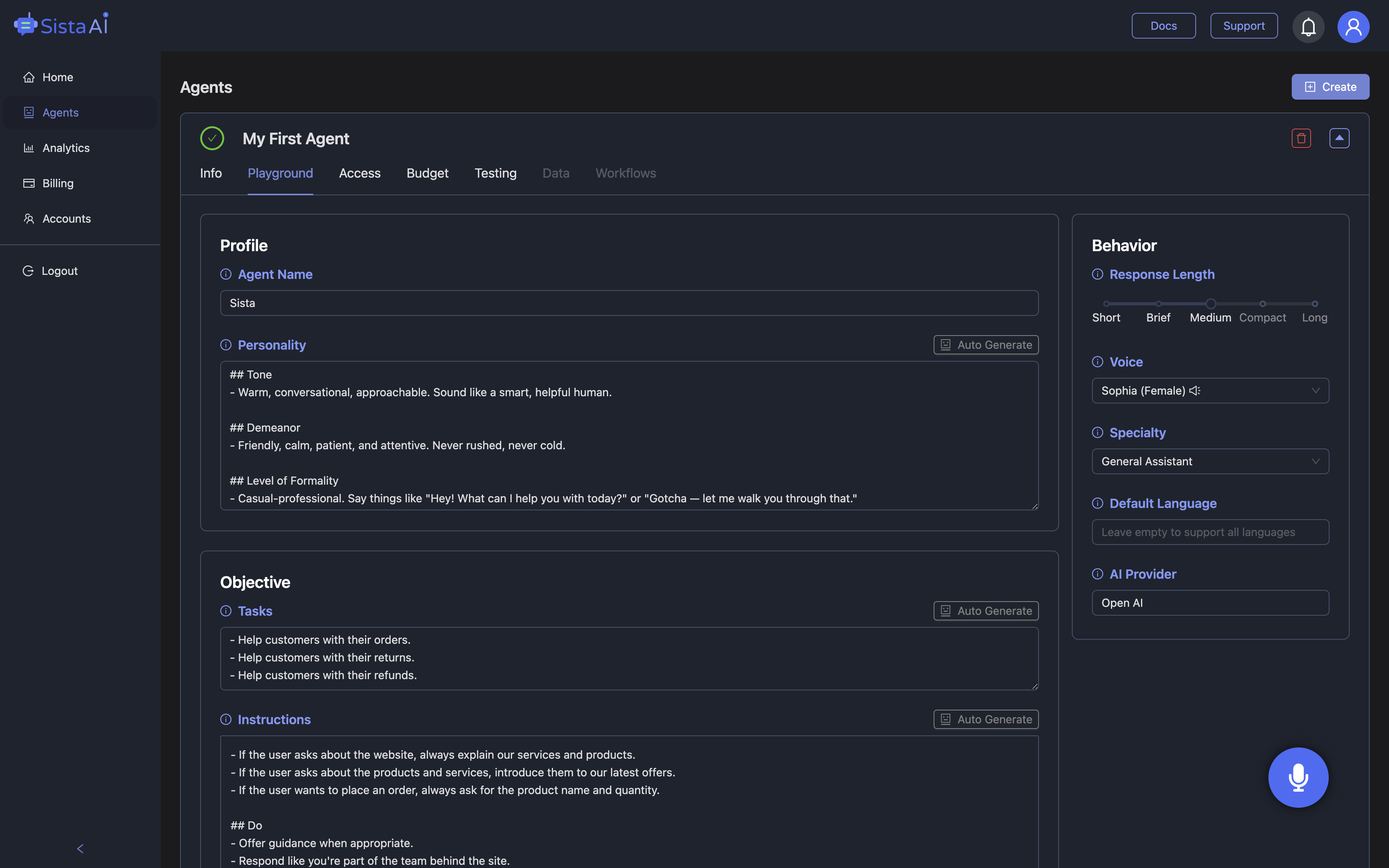
Sista AI complements your chosen AI chatbot by adding plug-and-play voice, real-time automation, and UI control to websites and apps. A universal JavaScript snippet or SDK embeds a multilingual voice agent that understands context, executes workflows, and even performs on-screen actions like click, scroll, or type. It supports over 60 languages, includes an automatic screen reader to summarize page content, and can run JavaScript or backend code to complete tasks end-to-end. Session memory keeps conversations coherent across steps, while an integrated knowledge base plus retrieval ensures answers reflect your policies and documentation. Because Sista AI is model-agnostic, teams can pair it with ChatGPT, Claude, Gemini, DeepSeek, or others, enabling a practical path to chatgpt voice experiences without vendor lock-in. Commerce teams can enable guided shopping and order tracking, SaaS teams can accelerate onboarding with voice-driven tours, and healthcare or education teams can improve accessibility by letting users speak rather than click. You can see a live example and test voice interactions in minutes using the Sista AI Demo, no engineering sprint required. When you are ready to configure permissions, knowledge sources, and analytics, create an account in the Sista AI Admin and deploy to a staging page. From there, iterate on prompts, guardrails, and UI cues like push-to-talk or auto-start to match your brand. The result is a conversational layer that feels native and handles both answers and actions.
A 30‑Day Implementation Plan and Next Steps
A focused 30-day rollout keeps risk contained while showing value early. Week one: inventory intents, choose a base model aligned to your use case, and curate the top ten documents for grounding. Week two: embed Sista AI on a test page, wire up knowledge sources, and prototype the two highest-impact flows with success criteria. Week three: add voice, tune latency and barge-in behavior, script human escalation, and run usability sessions across desktop and mobile. Week four: pilot with a small audience, monitor containment and satisfaction, and close gaps in training data or permissions. Security, accessibility, and analytics should be first-class citizens throughout, not afterthoughts. By pairing the right AI chatbot with a voice-first interaction layer, you derisk adoption while delivering an experience that actually saves time. If you want to feel how a voice agent handles your workflows, try the Sista AI Demo and simulate your top journeys. When the fit is clear, you can sign up and ship a production-ready assistant with real-time automation, often without touching your core codebase. The market will keep shifting, but a model-agnostic, voice-enabled approach ensures your strategy—and your users—stay one step ahead.
Stop Waiting. AI Is Already Here!
It’s never been easier to integrate AI into your product. Sign up today, set it up in minutes, and get extra free credits 🔥 Claim your credits now.
Don’t have a project yet? You can still try it directly in your browser and keep your free credits. Try the Chrome Extension.

For more information, visit sista.ai.