Why 2025 Is the Tipping Point
Across boardrooms and product teams, the question is no longer whether to use agents, but how fast to deploy them. The Future of AI Agents: A Complete Guide matters because 2025 marks a convergence of technological maturity, market pull, and funding velocity. Organizations are moving from pilots to production, helped by advances that stretch from dense GPU clusters to early, quantum-enhanced acceleration. Investment signals are unmistakable: a 2024 industry survey reported roughly three-quarters of companies plan to increase AI budgets, with agentic systems among the fastest-growing bets. Deployment windows of 18–36 months are becoming common as enterprises standardize data, security, and observability. Meanwhile, emerging markets can leapfrog legacy tooling, accelerating practical adoption. In short, the race is on to turn conversational interfaces into autonomous collaborators, not just helpers. The Future of AI Agents: A Complete Guide is about harnessing this moment with grounded strategy and credible execution.
From NLP to Strategic Reasoning (and Voice That Works)
Agent capabilities are maturing on three fronts: perception, reasoning, and action. We’re moving from basic NLP to human-level communication, from object recognition to complex scene understanding, and from rules to strategic, multi-step planning. Under the hood, multi-agent reasoning frameworks are evolving beyond today’s transformer-only stacks, fueled by real-time multimodal data streams. Users are also normalizing conversational UX thanks to chatgpt voice experiences, raising the bar for latency, memory, and on-screen control. This is where voice-first agents shine: they can listen, think, and execute tasks—navigating UI elements, filling forms, and calling tools in context. Sista AI’s approach aligns with this trajectory: real-time voice agents with session memory, ultra-low latency, and the ability to run code or trigger workflows, all while reading and summarizing what’s on screen. As agents gain autonomy, a reliable voice layer becomes the most intuitive bridge between humans and machine action.
Enterprise Readiness: ROI, Multi-LLM Ops, and Governance
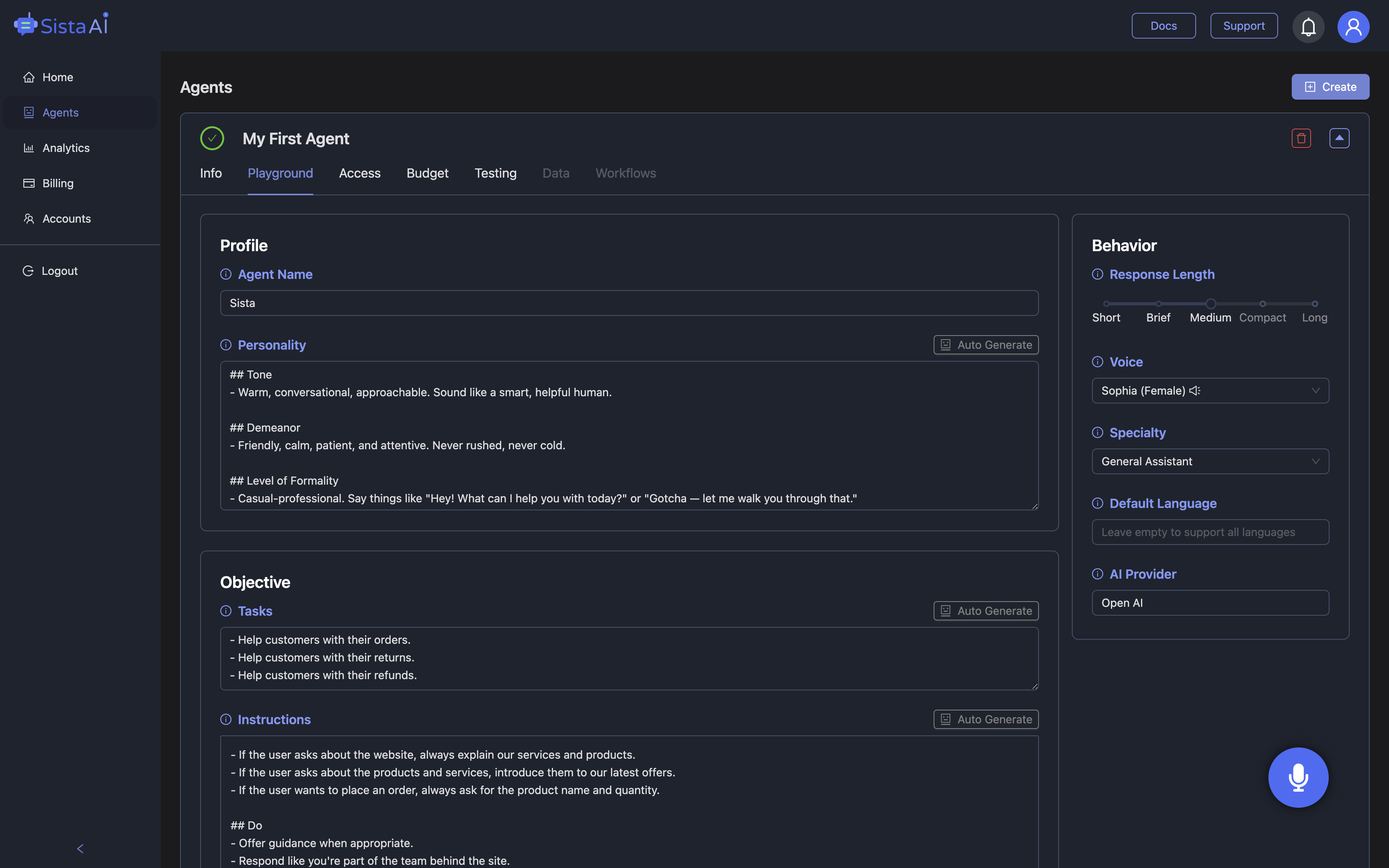
The biggest question in 2025 is not feasibility but value capture. Leaders are formalizing ROI models that track cycle-time reductions, cost-to-serve, and customer satisfaction, plus model-level metrics like tool-use accuracy and handoff precision. Many teams face a multi-LLM reality, balancing cost, latency, and quality across heterogeneous models; orchestration and evaluation pipelines are essential to keep agent behavior predictable. Governance must keep pace: versioning, permissions, audit logs, and guardrails protect brand, data, and stakeholders. Upskilling is equally important, as teams learn to supervise autonomous systems and design human-in-the-loop checkpoints. Analyst outlooks suggest a rapid autonomy curve, with a meaningful share of routine decisions shifting to AI agents over the next few years. Sista AI complements this enterprise journey with plug-and-play voice agents, a no-code dashboard, and consultancy that maps user journeys to safe, measurable automations—helping transform promising pilots into dependable operations.
Real Use Cases: Finance, Healthcare, and Customer Support
In finance, an agent might synthesize market signals, pre-check risk criteria, and prepare trades for human approval, targeting faster reaction times during volatility. A regional bank can route 24/7 voice inquiries to an agent that recognizes intent, authenticates users, and triggers workflows for balance queries or card controls, reducing queue times while improving auditability. In healthcare, agents can continuously parse patient notes, device data, and guidelines to propose next-step actions, escalating to clinicians with clean summaries and references. In customer service, voice agents can persist conversation state across channels, resolve multi-step issues, and escalate gracefully with full transcript context. Sista AI’s voice UI controller can navigate pages, type responses, and submit forms while its knowledge integrations ground answers in policy or product data. Multilingual support (60+ languages) means a single agent can serve global audiences consistently—without sacrificing speed, context, or compliance-conscious behavior.
Practical Roadmap and How Sista AI Fits
A pragmatic path starts with a well-scoped workflow: identify a repeatable process, define success metrics, and instrument it end-to-end. Next, pair your agent with trusted tools—databases, CRMs, analytics—so it can act, not just chat. Establish governance early, including permissioning, feedback loops, and human review at critical steps. Run controlled rollouts with A/B comparisons to de-risk scale-up. Sista AI is built for this reality: embeddable, voice-first agents that can summarize on-screen content, recall context, trigger automations, and execute code when needed, all wrapped in a no-code dashboard and SDKs for quick integration. If you want to see what a production-ready voice agent feels like, try the live Sista AI Demo and talk to it as you would a teammate. Ready to implement in your own product? You can sign up and deploy a pilot without re-architecting your stack.
Stop Waiting. AI Is Already Here!
It’s never been easier to integrate AI into your product. Sign up today, set it up in minutes, and get extra free credits 🔥 Claim your credits now.
Don’t have a project yet? You can still try it directly in your browser and keep your free credits. Try the Chrome Extension.

For more information, visit sista.ai.