Why Voice Interface Is the Next Default UI
The modern voice interface has crossed from novelty to necessity, driven by massive adoption and real technical breakthroughs. In the U.S., 62% of adults already use voice assistants, and 64% of households own an Echo device, with usage among younger generations expected to rise even further. What changed is speed and fidelity: real-time, speech-native systems now keep latency near or under 300 milliseconds, so conversations flow without awkward gaps. Add mid-sentence language switching, emotional inflection, and natural instruction-following, and the voice interface begins to feel genuinely human. Consumers now expect these experiences not only on smart speakers but inside mobile apps, cars, kiosks, and websites. Even chatgpt voice usage highlights how quickly people embrace hands-free, conversational controls for search, commands, and messaging. For businesses, this shift means rethinking onboarding, support, and navigation as voice-first pathways that simplify complex tasks. In 2025, the voice interface isn’t just an add-on; it’s becoming the default way people expect to interact with digital products.
The Tech Making Real Conversations Possible
Under the hood, today’s voice interface depends on speech-native architectures tuned for 250–350 millisecond round-trip budgets and resilient turn-taking. Systems like OpenAI’s GPT-realtime and GPT-4o, along with Google’s Gemini 1.5, combine speech, text, and vision so agents can understand context from voices, screenshots, or even video. WebRTC streams, lightweight ASR/TTS, and edge inference keep interactions snappy, while hybrid designs let on-device components handle wake words and privacy-sensitive steps. Emotional intelligence allows agents to detect stress, sarcasm, or frustration, adapting tone or escalating to humans when needed. In healthcare, voice biomarkers can flag early signs of Parkinson’s or Alzheimer’s, pushing voice into remote diagnostics and telemedicine workflows. The ecosystem is maturing fast: ElevenLabs raised $180M at a $3.3B valuation to advance expressive synthesis and cloning for branded assistants. Enterprise platforms like Azure Cognitive Services are scaling speech-to-text and multilingual pipelines across millions of apps. Even evaluation is evolving, with tools such as Braintrust and Evalion simulating emotional callers, scoring latency and flow, and offering Pro tiers around $249/month—evidence that production-grade voice test rigs are now a category of their own.
Design Principles That Separate Great from Frustrating
Winning with a voice interface means treating conversation as a UX discipline, not just a feature. Context awareness is paramount: remember session goals, user preferences, and recent actions so the assistant doesn’t repeat itself or lose the thread. Personalization pays off; research shows top companies that tailor experiences grow faster, and users increasingly expect assistants to adapt in real time. Emotional intelligence matters too—45% of users want smarter, more empathetic responses, especially in support and wellness scenarios. Quality also shows up in surprising places: 65% of learners can’t distinguish AI from human narration, which raises the bar for brand voice and content fidelity. Microinteractions—small confirmations, clarifying questions, and clear handoffs—prevent dead-ends, while multilingual handling ensures smooth locale switching. Privacy by design, including edge processing for sensitive steps, builds trust in regulated environments. Finally, multimodality improves task completion: voice plus a screenshot or barcode can resolve a support issue in seconds where text alone might fail.
Where Sista AI Fits in Your Stack
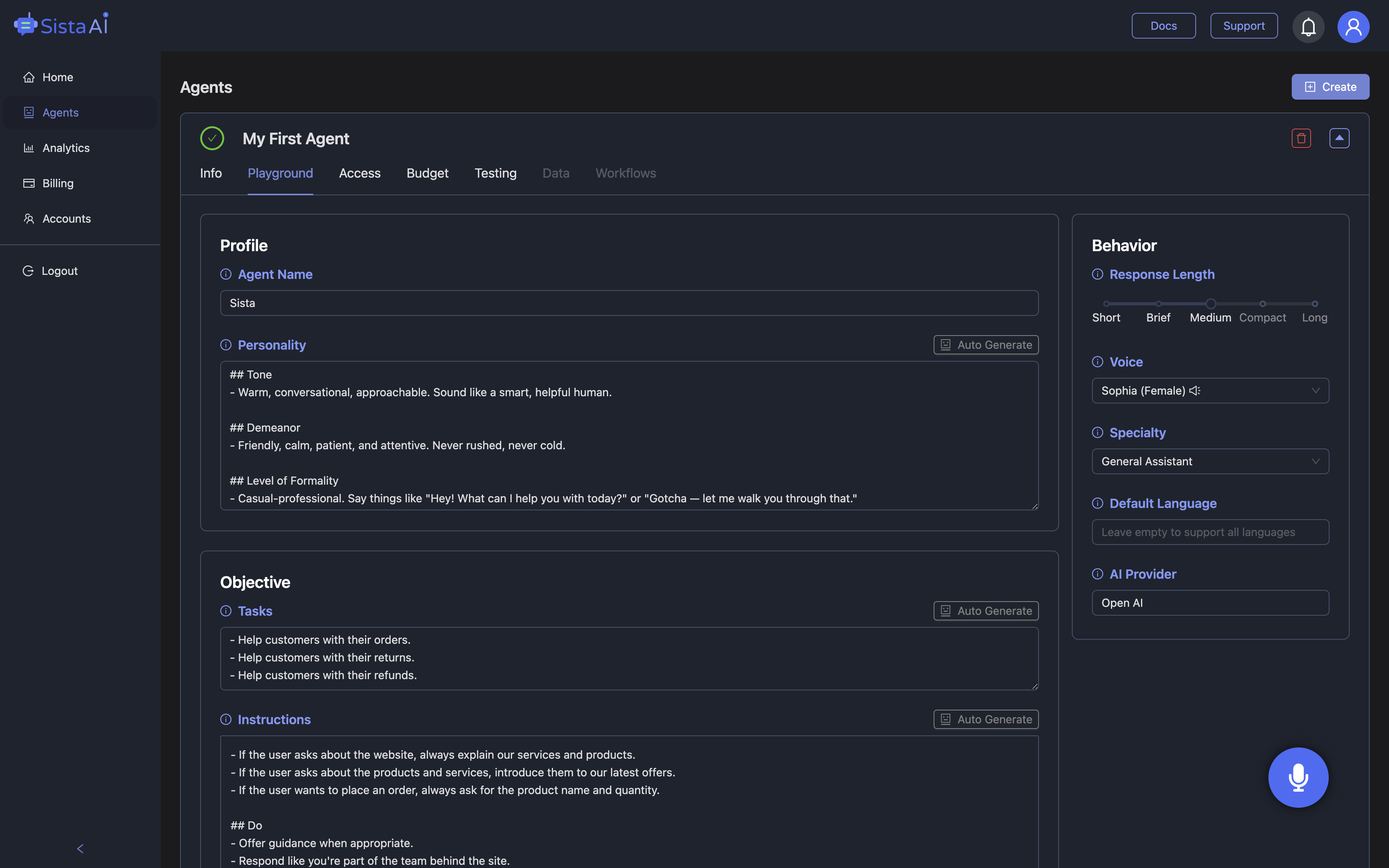
If you’re aiming to embed a production-ready voice interface without rebuilding your product, Sista AI was designed for exactly that. Its plug-and-play voice agents drop into websites and apps with universal JavaScript snippets, SDKs, and platform plugins for React, Shopify, WordPress, and more. Beyond conversation, Sista AI acts as a Voice UI Controller that can scroll, click, type, and navigate on command, turning spoken intent into UI actions. Built-in workflow automation lets the agent complete multi-step flows—think account updates, ticket filing, or onboarding checklists—while a no-code dashboard manages personas, permissions, and usage. Multilingual recognition supports 60+ languages, and integrated RAG connects your knowledge base so the agent answers with your documentation, not guesswork. Real-time performance targets sub-300ms responsiveness, keeping interactions fluid and human-like. Teams use it for guided shopping, support triage, accessibility enhancements, and voice-driven forms across SaaS, healthcare, education, and e-commerce. You can experience the interaction quality firsthand in the Sista AI Demo, which showcases voice AI and automation working together in a realistic setting.
A Practical Roadmap to Launch
Start with a thin slice: pick one journey where a voice interface reduces friction—product discovery, appointment scheduling, or support intake—and define success metrics like time-to-resolution, escalation rate, or completion rate. Deploy a small pilot using Sista AI’s JS snippet, connect your knowledge base, and add a few safe, well-defined tools for actions such as lookup, form submission, or cart updates. Test latency and flow with real users and scripted callers, including multilingual and emotionally varied scenarios, before expanding to more tasks. For privacy-sensitive contexts, keep wake-word detection and basic parsing on-device and reserve complex reasoning for the cloud. In customer-facing sites, enable session memory for continuity, but set clear boundaries and retention rules. Iterate weekly: tighten prompts, refine guardrails, and add microinteractions that clarify next steps. When the pilot meets your thresholds, scale to more pages or channels and monitor live KPIs in the dashboard. If you’re ready to explore quickly, try the Sista AI Demo to see how voice and automation feel in practice, then sign up to configure your first production agent in minutes.
Stop Waiting. AI Is Already Here!
It’s never been easier to integrate AI into your product. Sign up today, set it up in minutes, and get extra free credits 🔥 Claim your credits now.
Don’t have a project yet? You can still try it directly in your browser and keep your free credits. Try the Chrome Extension.

For more information, visit sista.ai.