Why Low code AI Agent strategies are winning now
Teams have promised smarter customer experiences for years, yet shipping useful automation often stalls on custom code, brittle integrations, and long QA cycles. A Low code AI Agent changes that by combining visual orchestration, reusable components, and built-in governance so non-engineers can launch iteratively without sacrificing control. Unlike simple chat widgets, modern agents plan multi-step tasks, call tools, and learn from knowledge bases while handing off to humans when needed. The rise of voice interfaces and "chatgpt voice" expectations raises the bar further, as users want to talk, not click, especially on mobile. Product managers now routinely pilot agents for support triage, onboarding walkthroughs, and guided shopping, then expand based on data. Practical wins include 24/7 coverage, consistent policy enforcement, and faster resolutions. The real shift is cultural: a Low code AI Agent lets business teams own outcomes while engineering sets guardrails. That combination accelerates iteration and de-risks adoption across web, mobile, and in-product flows.
Mapping the 2025 landscape in plain terms
Comparative reviews in 2025 cover between 10 and 15 tools at a time, and one examined 14 platforms end-to-end, showing how far the space has matured. Vellum AI stands out for enterprises that need a visual builder plus an SDK, complete with RBAC, audit logs, evaluations, and flexible deployment (cloud, VPC, on‑prem). On the other end, n8n’s open-source workflows excel at integrations and drag-and-drop logic, though it lacks built-in agent evaluations and deep governance out of the box; its cloud starts around $20/month. Recomi converts business data into ready-to-use assistants for support and growth, emphasizing quick web embedding for non-technical teams. AgentGPT enables browser-based experimentation and goal-driven agents, with a Pro tier around $40/month. Frameworks like LangChain and CrewAI still dominate complex builds for developers who need fine-grained control. Langflow offers a visual canvas for prototyping RAG and multi-agent systems without heavy coding. The throughline is clear: the best Low code AI Agent balances usability with observability, security, and integrations that fit your stack and risk profile.
A practical blueprint to ship your first Low code AI Agent
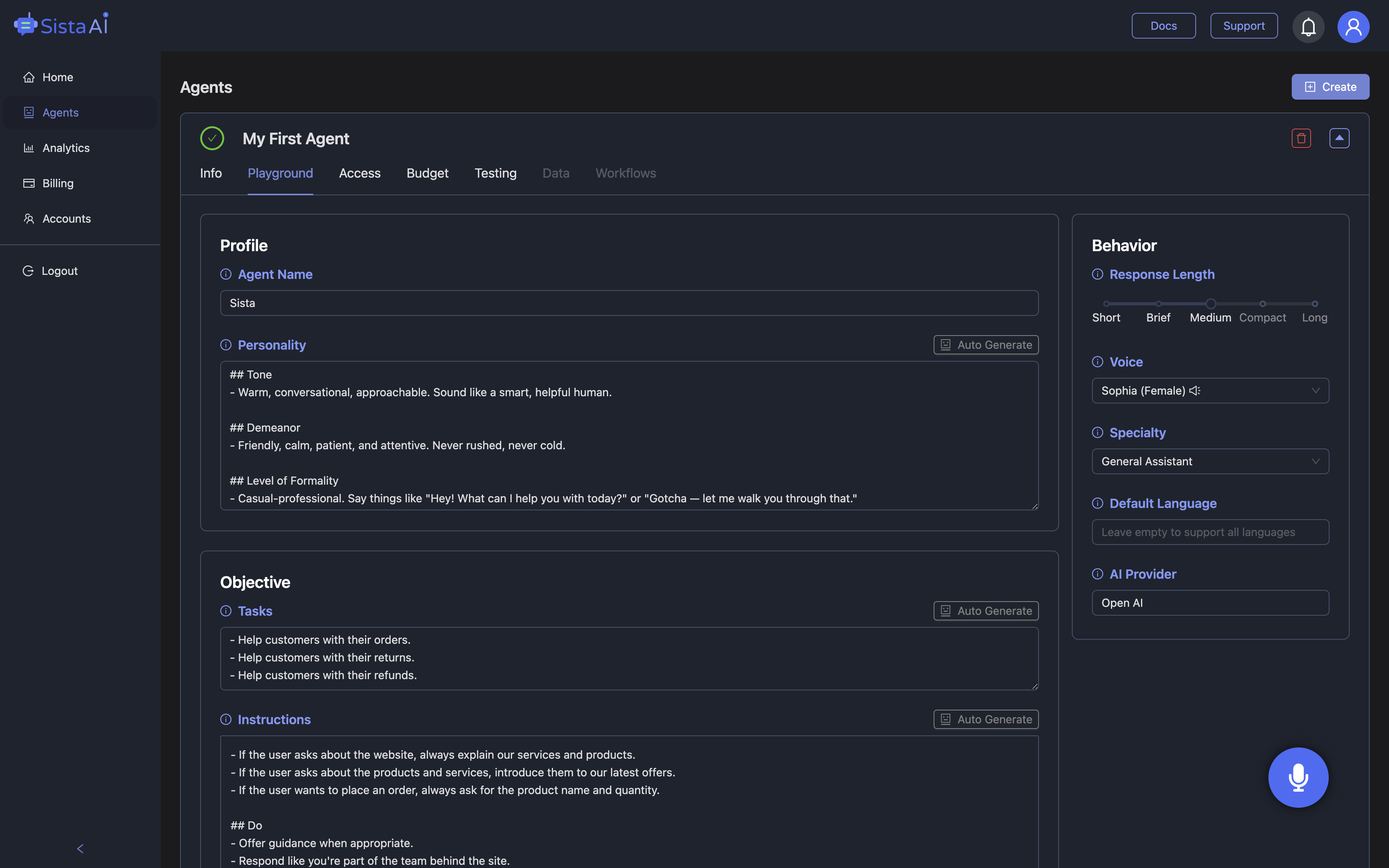
Start by defining a crisp job-to-be-done—like “deflect repetitive Level 1 support issues while preserving CSAT”—and list the knowledge sources and tools the agent must use. Next, choose an environment that supports safe iteration: versioning, sandbox evaluations, and analytics are must-haves. Map data access via RAG and permissions for any actions (tickets, CRM updates, scheduling) the agent will take. This is where Sista AI earns a place on shortlists: its plug-and-play voice agent adds a voice UI controller, runs JavaScript or backend tasks, and works in over 60 languages with session memory and integrated knowledge bases. Installation is a universal JS snippet or SDK, with options for React, Shopify, and WordPress, so pilots launch in hours, not weeks. Real-time latency ensures voice feels natural, which matters for mobile and accessibility. If you want to see this flow in action, explore the Sista AI Demo and speak to the agent as you would to a teammate.
Voice-first use cases that move the needle
Voice is becoming the front door to digital products, and a Low code AI Agent lets you pilot it safely. In e-commerce, a conversational assistant can filter products by natural language, manage the cart, and check order status, then escalate to a human for edge cases. For SaaS, agents onboard new users by explaining screens, filling forms on command, and triggering workflows—no hunting through docs required. Support teams route issues more precisely by verifying intent, extracting entities, and enriching tickets before they reach a queue. Accessibility gains are immediate: a built-in screen reader summarizes on-page content, while voice navigation reduces friction for everyone, not just users with disabilities. If your audience already expects "chatgpt voice" responsiveness, an embedded, low-latency agent keeps you aligned with that standard. Sista AI’s Shopify-focused variant adds guided shopping, promotion awareness, and checkout help, while its website agent controls UI elements directly, making voice interactions feel native rather than bolted on.
Governance, measurement, and a sensible rollout
Operational success hinges on governance and observability: role-based access, audit logs, and clear boundaries for what the agent may read or do. Borrow a staged rollout from DevOps—pilot in a sandbox, run evaluations against realistic transcripts, then canary release to a small segment before full traffic. Track core metrics such as containment rate, time-to-resolution, handoff quality, and sentiment by intent, not just overall volume. Establish a human-in-the-loop policy for high-risk intents and ensure transcripts are redacted and retained per compliance. For regulated industries, prefer platforms that mirror Vellum-like controls while still supporting rapid iteration. When you’re ready to operationalize voice automation with real user impact, Sista AI can help—from quick pilots to production rollouts—through its plug-and-play agents and advisory services. Create your workspace in minutes via the Sista AI Signup, then iterate with a small, measurable use case. If you’d like to validate fit before committing, try the hands-on Sista AI Demo and evaluate voice plus automation in your own browser.
Stop Waiting. AI Is Already Here!
It’s never been easier to integrate AI into your product. Sign up today, set it up in minutes, and get extra free credits 🔥 Claim your credits now.
Don’t have a project yet? You can still try it directly in your browser and keep your free credits. Try the Chrome Extension.

For more information, visit sista.ai.