Why AI prompt reuse is suddenly a marketing superpower
Most teams don’t struggle with ideas—they struggle with repeatability. You can get a decent first draft from an AI in minutes, but getting the same level of quality tomorrow, across a different channel, with a different objective, is where cycles get wasted. That’s exactly why AI prompt reuse is becoming a core workflow in 2025 marketing teams: it turns one-off “lucky prompts” into dependable templates. The golden rule is simple: clear, specific prompts packed with context produce clearer outputs, while vague prompts create vague content. In practice, that means adding the audience, the offer, the tone, the channel, and a concrete goal before you hit send. Many marketers also iterate rather than gamble—follow-up prompts refine the asset until it matches expectations. The result is less time spent rewriting and more time spent deciding what to publish. When you treat prompts like reusable assets, you start building a library that compounds over time.
What “reusable” really means: templates with variables, guardrails, and examples
AI prompt reuse isn’t copy-paste; it’s structured reuse with a few blanks to fill in. A reusable prompt template typically includes variables (product, audience segment, pain point, channel), constraints (word count, reading level, compliance rules), and examples of what “good” looks like. Marketers report that context matters as much as instructions—details like audience, tone, and messaging are often what separates a generic output from a publishable one. Precise instructions also matter: specifying format and deliverables reduces back-and-forth and prevents “surprise” responses. Many teams need about three prompt rounds to reach the desired result, but only minor edits afterward—an important signal that templates plus iteration beat endless rewriting. If you’re using a prompt manager, store not just the final prompt, but also the best follow-ups that reliably fix common issues (like making a headline sharper or tightening a CTA). Over time, that becomes your team’s playbook for consistency. Reusable prompts work best when they reflect your brand voice in writing, not just your topic in keywords.
Iterative refinement: the loop that makes AI prompt reuse dependable
The fastest teams don’t expect perfection on prompt one; they design a refinement loop. Techniques like role prompting (e.g., “act as a lifecycle marketer”), task decomposition (break a campaign into emails, ads, landing page sections), and constrained prompting (approved claims only) make outputs more reliable across channels. Few-shot examples—showing two or three short samples of your brand voice—can reduce drift when you reuse a prompt weeks later. For more complex work, a reusable “critic” step is powerful: ask the model to audit its own draft against your requirements, then revise. This is where AI prompt reuse shines, because you can standardize the loop: Draft → Evaluate → Improve, instead of reinventing the process each time. Teams that test prompt templates across different models also tend to catch fragility early, before workflows scale. And for security-minded orgs, keeping prompts structured and explicit helps reduce the risk of the model being led off-task by adversarial or irrelevant inputs. Done well, iteration becomes the engine that turns a good template into a robust system.
Marketing workflows where prompt reuse shows measurable lift
Marketing leaders increasingly track prompt performance like they track creative performance. When prompts are reused across campaigns and channels, teams can compare outcomes with cleaner baselines: impressions, clicks, time-on-page, form completions, and A/B tests with holdouts. Some teams report that prompt-driven workflows correlate with higher reuse of creative assets (often cited around 20%), alongside meaningful lifts in CTR and conversion rates when prompts are tuned to audience and channel. A practical rhythm is weekly: refresh a dashboard, review what’s working, and adjust templates if a lift exceeds a meaningful threshold—or if performance stagnates for a few weeks. AI prompt reuse is especially effective for social media calendars because the structure repeats even when the ideas change: create the monthly theme, generate channel-specific posts, then produce variations for peak activity windows. One prompt can output Instagram captions, TikTok hooks, LinkedIn intros, and YouTube descriptions with consistent voice if you define the constraints upfront. The win is not just speed; it’s coordination, because everyone starts from the same rules. This is also where a prompt manager pays off by centralizing templates, versioning changes, and preventing “prompt drift” across team members.
Where Sista AI fits: turning prompt libraries into real, customer-facing experiences
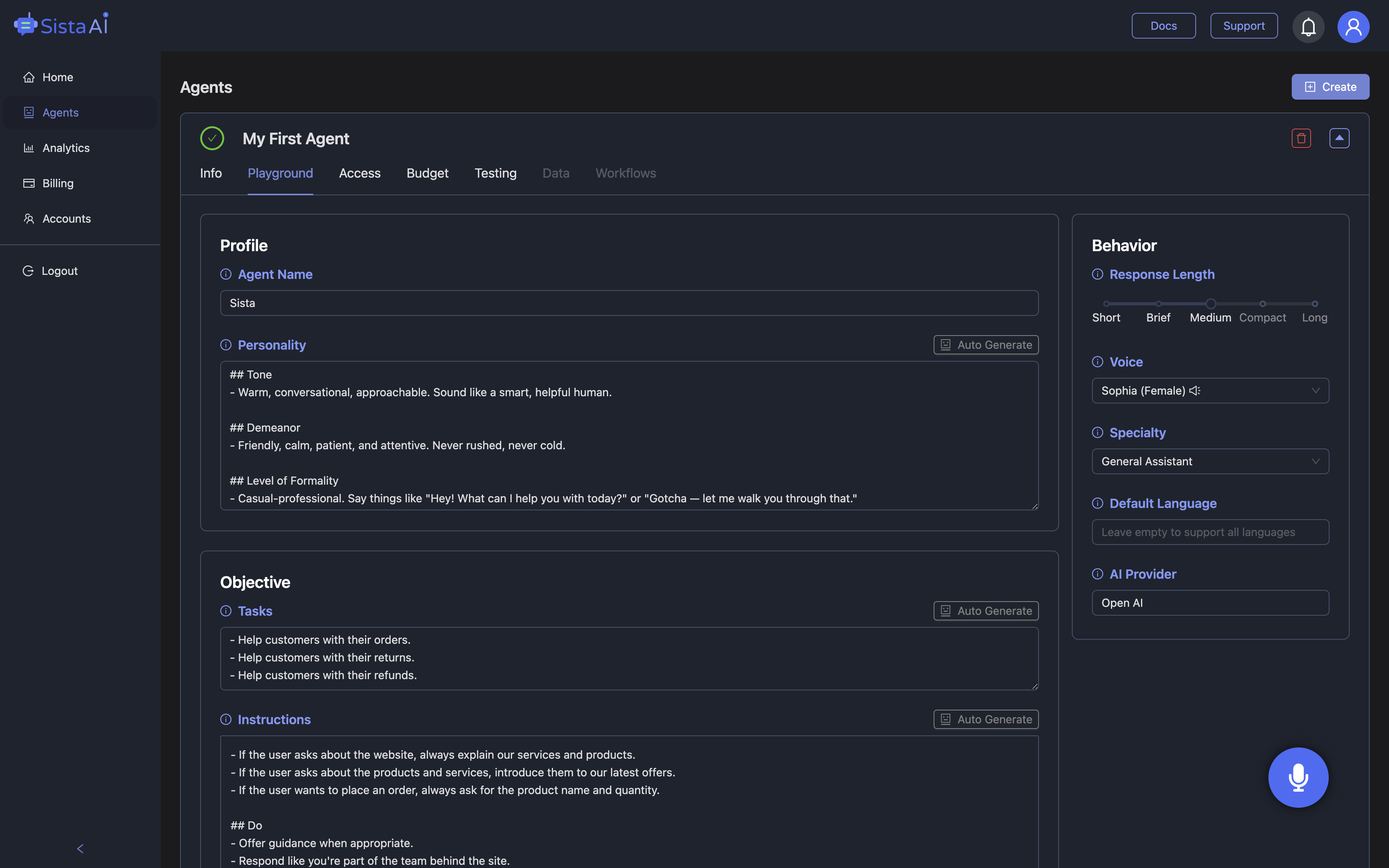
Prompt reuse isn’t limited to internal content creation; it can also standardize how customers experience your brand in real time. If your website has an assistant answering product questions, guiding onboarding, or handling support, you want those interactions to be consistent, compliant, and on-brand—exactly the kind of job reusable system prompts and workflows are built for. Sista AI’s plug-and-play voice agents are designed for that kind of deployment: a structured base prompt defines the agent’s role, tone, permissions, and escalation rules, while reusable sub-prompts handle recurring tasks like summarizing a page, explaining pricing, or walking through a form. You can explore what a voice-first experience feels like in the Sista AI Demo, then adapt that approach to your own site content and customer journeys. Because the agent can work with knowledge bases and on-screen context, reusable prompts become a governance tool—not just a creativity tool. The same principle applies to e-commerce flows, where consistent product discovery questions and comparison logic can be reused session after session. When prompt reuse is treated as product design, not just drafting, the customer experience becomes faster, clearer, and more trustworthy.
How to start building your prompt reuse system this week
Start by choosing three repeatable tasks you do every week—like campaign briefs, social post variations, and landing page rewrites—and write one reusable template for each. For every template, include: the objective, the audience segment, brand voice notes, required format, and at least one example you’d be happy to publish. Then formalize the refinement loop with two follow-ups: one for tightening and one for compliance/accuracy checks. Store each template and its best follow-ups in a shared prompt manager, and version them the way you version creative assets. Add simple success criteria so you can evaluate whether changes help: time saved, fewer edits, or uplift in clicks and conversions. Most importantly, treat prompts as living documents—update them weekly based on results instead of rewriting from scratch. If you want to see how reusable prompts translate into a real conversational workflow, spend a few minutes in the Sista AI Demo, then map your top customer questions into reusable “answer + next step” modules. And when you’re ready to centralize and deploy those workflows, create your workspace via Sista AI Signup so you can manage and iterate in one place.
Stop Waiting. AI Is Already Here!
It’s never been easier to integrate AI into your product. Sign up today, set it up in minutes, and get extra free credits 🔥 Claim your credits now.
Don’t have a project yet? You can still try it directly in your browser and keep your free credits. Try the Chrome Extension.

For more information, visit sista.ai.