Why Google’s Voice Moment Matters Now
The Ai voice Assistant Google ecosystem has entered a pivotal year because users are shifting from typing to talking for real work. In 2025, a U.S. survey indicates 55% of people now turn to AI chatbots—including Google’s Gemini and OpenAI’s chatgpt voice—for tasks they once handled through traditional search. Traffic from generative AI platforms is growing roughly 165 times faster than from classic search engines, with about 13 million U.S. adults using AI chat as their primary way to explore information. That sea change makes Google’s direction in voice a strategic signal for product leaders, marketers, and engineers. Google Assistant already led on intelligence and integrations, and Gemini adds deeper reasoning, better context, and more fluent conversation. This isn’t just about setting reminders or lights anymore; it’s about research-level help that can handle follow-ups and nuance. If your product’s value depends on fast answers, guided workflows, or hands-free access, the Ai voice Assistant Google trajectory should inform your roadmap. The opportunity is to meet users where they increasingly are—in a natural, spoken dialogue that gets things done without screens full of menus.
From Commands to Conversations
Google’s Gemini evolves the Ai voice Assistant Google from a command executor to a conversational partner that can reason across multi-step questions. Users can ask complex queries, get concise summaries, and then continue with follow-up prompts without repeating context. On phones, Google is piloting a blended experience where AI Overview and conversational modes work together, letting someone start a search and naturally keep going like a chat. In Android Auto, this feels especially impactful: drivers can brainstorm trip ideas, ask for detours with constraints, and request quick summaries—all safely hands-free. Daily tasks also get smarter: 2025 features like real-time voice translation improve accuracy on idioms and tone, while voicemail handling and deeper personalization reduce routine busywork. Compared with alternatives, chatgpt voice set a high bar for human-like speech and patience; Gemini aims to meet or exceed that standard inside Google’s ecosystem. The net effect is that voice moves from convenience feature to everyday research assistant. For teams building products, it raises a practical question: how can your in-app help feel as fluid and forgiving as users now expect from Ai voice Assistant Google experiences?
Smart Homes, Smarter Conversations
With Gemini for Home, Google reframes the smart home as a proactive assistant that can understand interruptions, handle chained commands, and analyze context across devices. It reportedly supports over 100 use cases, from cooking guidance and travel planning to practicing conversations. A standout capability is camera awareness for subscribers: you can ask whether a package arrived at 2 p.m., or what your pet did in the living room, and the system will scan recorded footage to answer. That’s a leap from simple motion alerts to on-demand, question-driven scene understanding. Interestingly, while smart speaker ownership dipped slightly in the U.S. (from about 35% in 2023 to roughly 34% in 2025 among adults 12+), usage is evolving rather than disappearing. People still want quick control, but they increasingly expect deeper knowledge and follow-up—exactly what Ai voice Assistant Google advances are designed to deliver. Imagine telling your home, “Turn off the nursery lights after bedtime, start the dishwasher at 11, and remind me to message Sarah if the camera sees the courier.” It’s multi-intent, context-rich, and closer to natural conversation than rigid scripts.
What This Means for Your Website or App
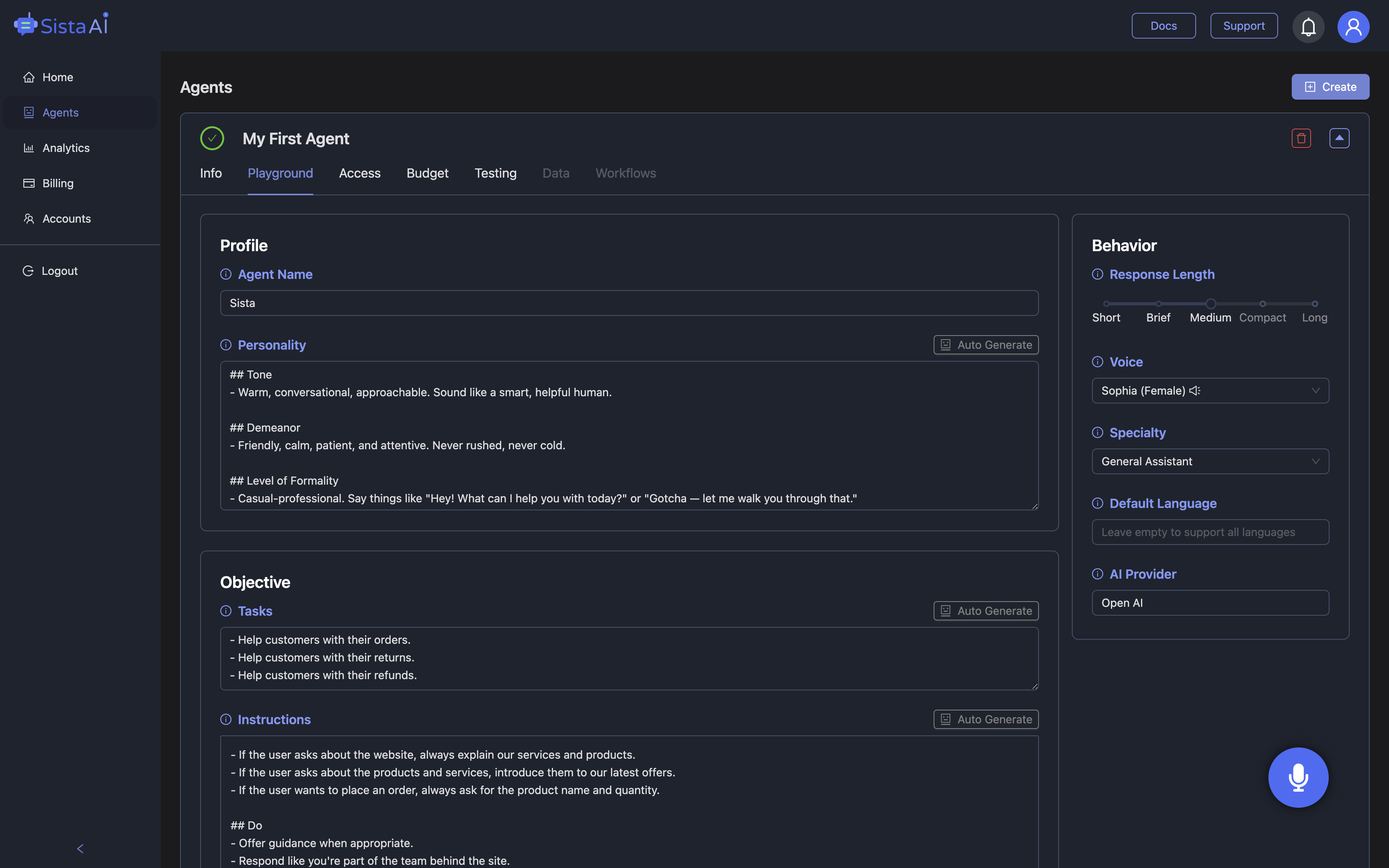
As users embrace conversational computing, they expect the same fluidity beyond Google’s properties—on your website, inside your SaaS, and throughout your customer flows. That’s where a product-side voice layer matters: instant answers from your knowledge base, hands-free UI navigation, and automated multi-step tasks. Sista AI brings a plug-and-play voice agent that mirrors the responsiveness people now associate with Ai voice Assistant Google experiences, while remaining fully embedded in your product. It can control UI by voice (scroll, click, type), automate workflows like onboarding or checkout, and handle multilingual recognition across 60+ languages. For example, an e-commerce store can offer voice-based product discovery, comparisons, and smart cart assistance that feels like a personal shopper. A healthcare portal can guide patients to the right form, summarize instructions, and schedule follow-ups without long menus. Setup is practical: a universal JS snippet or platform plugin, a no-code dashboard to tune behavior, and integrated RAG to draw from your knowledge sources. To see how this works in practice, try the Sista AI Demo and imagine it speaking your brand’s voice.
A Practical Roadmap to Voice-First Experiences
Start by mapping the top journeys where conversation beats clicks: onboarding, troubleshooting, billing questions, or guided shopping. Define 15–25 intents that account for 70–80% of volume, then add guardrails for authentication, data access, and human handoff. Pair intent detection with a knowledge base so answers reflect your policy and tone, not just generic web results. For mobile contexts, optimize for interruptions and follow-ups—users will change their minds mid-command, just like they do with Ai voice Assistant Google. Measure time-to-answer, self-serve rate, and resolution quality to track impact on support costs and conversion. If you have a smart home or in-car angle, consider how hands-free interactions can reduce friction and boost safety. Sista AI can help teams implement this roadmap with plug-and-play agents, platform plugins, and advisory support when you need architecture or workflow design. If you’re ready to experiment, spin up a proof of concept with the Sista AI Demo, then roll it out to a live cohort by creating your account at Sista AI Signup. The fastest wins come from focused journeys and clear metrics; the compounding returns come from making voice a first-class part of your product.
Stop Waiting. AI Is Already Here!
It’s never been easier to integrate AI into your product. Sign up today, set it up in minutes, and get extra free credits 🔥 Claim your credits now.
Don’t have a project yet? You can still try it directly in your browser and keep your free credits. Try the Chrome Extension.

For more information, visit sista.ai.